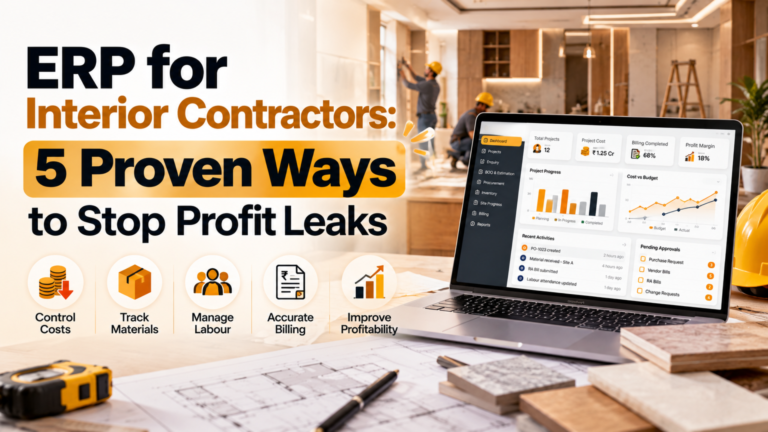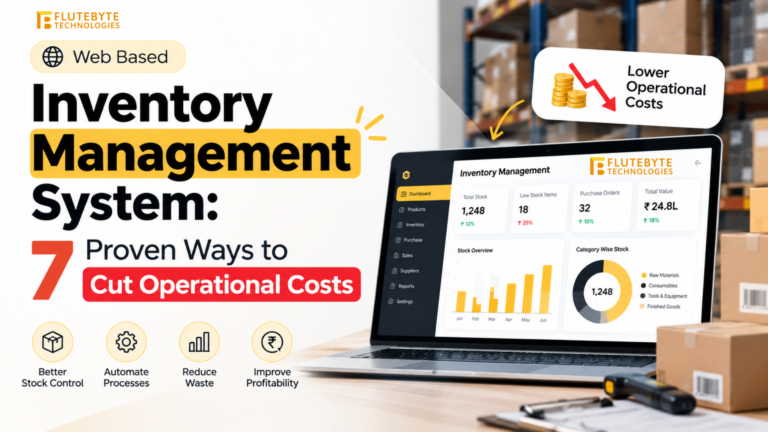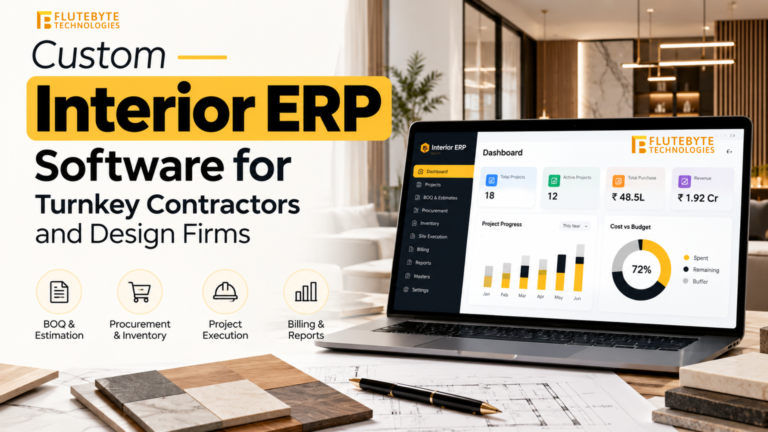
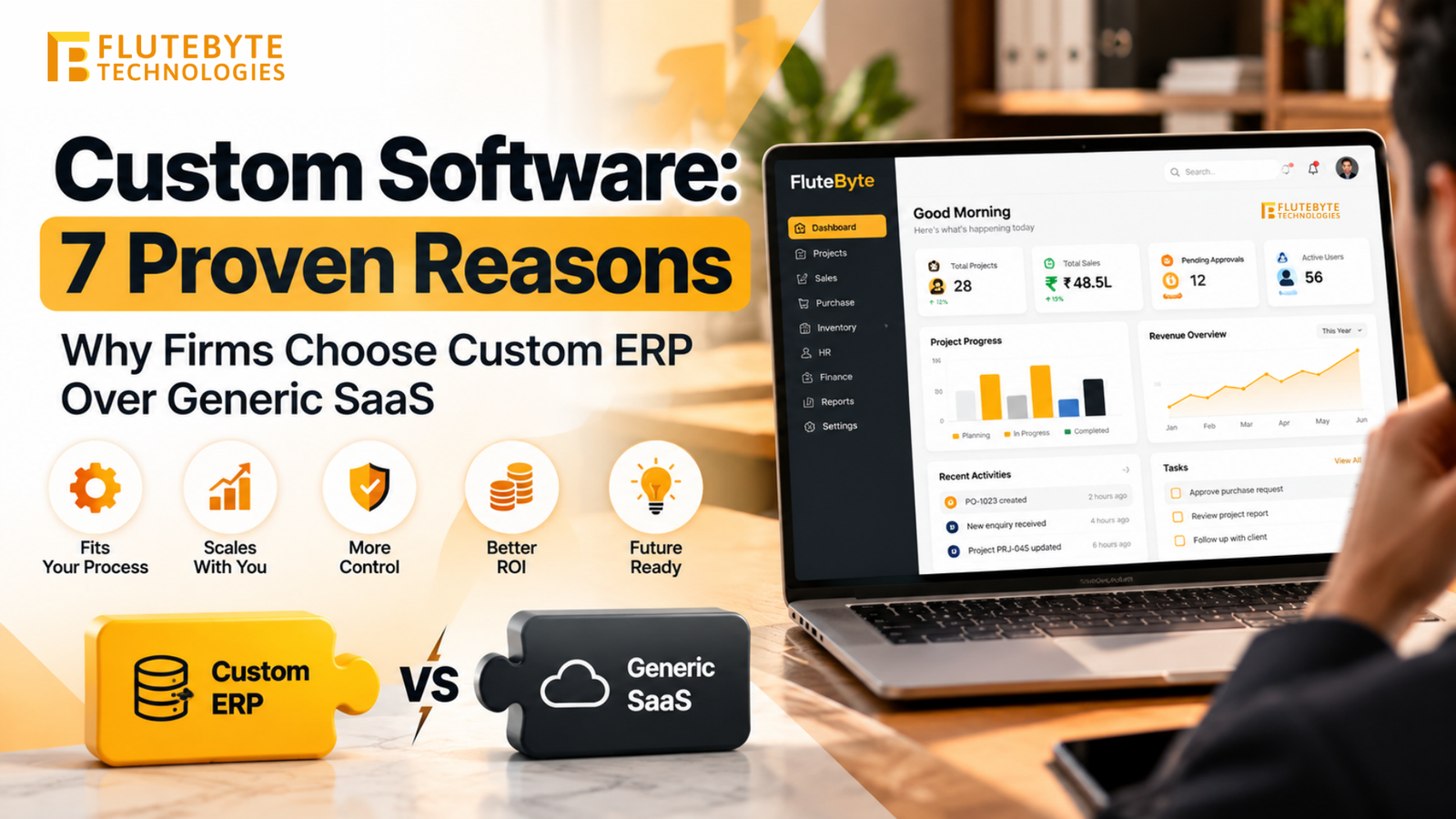
Running an interior contracting, turnkey commercial fit-out, or specialized civil manufacturing business past 10 crore INR in annual revenue exposes operational fractures. What once worked on Google Sheets and WhatsApp groups begins to fail. Purchase orders get lost, site engineers order excess tiles without approvals, and office accountants spend days reconciling subcontractor running bills against physical measurement sheets.
At this inflection point, business owners turn to commercial off-the-shelf ERP systems. Most discover that generic platforms impose rigid data models that do not mirror actual site execution.
Investing in FluteByte custom software replaces fragmented desktop spreadsheets with a custom system engineered around your exact procurement policies, bill of quantities (BOQ) structures, and field realities.
Table of Contents
The Operational Pitfalls of Generic Commercial ERPs
Commercial enterprise software packages are built to serve thousands of horizontal businesses. To maximize total addressable market, a single off-the-shelf platform attempts to satisfy a retail chain, an automotive supplier, a pharmaceutical distributor, and a construction contractor using identical foundational code.
This broad focus forces construction and fit-out firms into two major compromises:
[Off-The-Shelf ERP]
       │
       ├── Heavy Customization Fees (Months of external consultant billing)
       ├── Unused Feature Bloat (Depreciation on mining tools, point-of-sale retail)
       └── Rigid Database Structure (Forces field teams back to WhatsApp & paper)
- Forced Operational Alteration: Standard systems demand that you change how your supervisors measure work, how your procurement desk compares vendor quotes, and how your factory cuts raw materials. If your team requires a two-step validation for material issues above 50,000 INR, but the software only allows a single blanket approval, your internal accountability breaks down.
- Consultant Lock-In: Every minor field change, custom invoice layout, or site measurement adjustment requires booking billable hours with external implementation agencies. According to enterprise implementation studies published by research organizations like Gartner, over 55% of standard ERP implementations fail to meet operational objectives due to poor usability and integration friction.
When teams encounter software friction, they stop using it. Site supervisors return to paper notebooks. Project managers track client variations on personal spreadsheets. The company continues paying monthly software fees while running daily operations completely offline.
Why FluteByte Custom Software Eliminates Operational Bottlenecks
FluteByte custom software approaches operational digitisation from the exact opposite direction. Rather than requiring you to adopt generic enterprise structures, the engineering team analyzes your physical operations first.
1. Workflow-First Architectural Mapping
Every contracting business holds unique advantages in how it bids, buys materials, and supervises sub-agencies. FluteByte documents your exact approval gates, site store procedures, and subcontractor retention release criteria before writing a single line of code. The resulting system codifies your competitive operational practices directly into code.
2. Elimination of Feature Bloat
Commercial software charges you for modules you will never open. A typical turnkey contractor does not need retail barcode scanning, multi-currency foreign exchange hedging, or heavy asset mining depreciation schedules. FluteByte builds clean interfaces containing only the precise tools your staff uses daily. This simplicity speeds up page load times and cuts new staff onboarding time from weeks to hours.
3. Direct Code Ownership and Autonomy
When you build your platform with FluteByte, your company retains full rights to the intellectual property. You host the application on your own secure private cloud, retain unmetered access to your PostgreSQL or MySQL database, and never face sudden account suspensions or unilateral license price increases from a software landlord.
Five Workflow Bottlenecks Fixed by FluteByte Custom Software
Fit-out contractors and manufacturing workshops lose their profit margins in five operational gaps. Here is how FluteByte automates each stage:
BOQ Import ──> Vendor Rate Comparison ──> PO Release ──> Mobile GRN ──> RA Bill Settlement
1. Automated BOQ Parsing and Cost Control
Manual data entry of estimation spreadsheets wastes dozens of engineering hours per tender. FluteByte develops direct parsing utilities that accept your client estimation sheets in Excel or CSV formats.
The software splits line items automatically into:
- Raw materials (plywood, laminates, hardware, adhesives)
- Direct carpentry and civil labor rates
- Subcontractor turn-key packages (HVAC, fire fighting, electrical)
- Internal gross profit margins
Once the client signs the estimate, the system locks the baseline budget. Project managers cannot issue purchase indents that exceed approved line-item allowances without formal, recorded change-order sign-offs from management.
2. Purchase Order Generation and Multi-Vendor Price Analysis
Procurement desks often purchase from habit rather than pricing discipline. FluteByte integrates a structured Request for Quotation (RFQ) module. When site supervisors raise material indents, your purchase team sends automated digital RFQs to approved vendors.
The system arranges incoming bids into a side-by-side comparative matrix detailing base prices, freight costs, payment terms, and GST rates. Once approved, the software converts the chosen quote into a formal Purchase Order (PO) with one click, automatically notifying the vendor and your accounting desk.
3. Job-Site Goods Receipt Notes (GRN) and Three-Way Reconciliation
Material loss frequently occurs between the supplier’s warehouse and the job site. FluteByte provides a mobile-first site store module.
When a truck arrives at the site:
- The site storekeeper opens the purchase order on a smartphone.
- The storekeeper enters the verified count of items received.
- The storekeeper photographs the physical delivery challan and the material batch directly through the camera.
- The system compares the quantities on the PO, the delivery challan, and the physical count.
If a supplier ships 180 sheets of commercial plywood on an order of 200, the software records a partial GRN. Your accounting team cannot mistakenly process the vendor invoice for the full amount.
4. Subcontractor Running Account (RA) Billing
Subcontractor accounting presents substantial administrative drag. Fit-out companies must track work completion percentages, previous bill deductions, material advances, and statutory retentions across multiple active sites.
FluteByte builds custom measurement sheets directly into the billing engine. Site engineers log physical dimensions ($length \times width \times height$) completed by carpentry, painting, or tiling crews. The software applies agreed contractual unit rates, deducts 5% retention money, claws back material debits issued from your central store, and prepares the net payment voucher automatically.
5. Dual-Track Payroll: Office Staff and Daily Site Labor
Standard corporate HRMS systems fail in contracting environments because they expect every employee to sit in an office with a biometrics scanner.
FluteByte develops a split-workforce HR module:
- Office & Engineering Staff: Calculates standard monthly salaries, professional tax, provident fund deductions, and performance bonuses.
- Site Labor & Gang Crews: Tracks daily attendance via foreman headcounts, supervisor photo check-ins, or field geotagging. It handles daily allowances, piece-rate square-foot payouts, and weekly advances, linking all labor costs directly to the specific project’s profit and loss ledger.
Cost Comparison: Generic SaaS Subscriptions vs FluteByte Custom Software
Off-the-shelf software vendors market their solutions on a seemingly low monthly per-user fee. As your business grows, this pricing model penalizes your expansion.
Consider a mid-sized commercial turnkey firm with 40 active platform users:
- 5 Project Directors and Estimators
- 8 Purchase and Store Managers
- 4 Accounts and HR Professionals
- 23 Site Supervisors, Quality Engineers, and Safety Inspectors
The Five-Year Financial Reality
Yearly Spend Comparison (In INR Lakhs)

Year    Commercial SaaS (Per User)    FluteByte Custom Build
────────────────────────────────────────────────────────────
Year 1         14.4 Lakhs                   18.0 Lakhs (One-time build)
Year 2         15.8 Lakhs                    1.8 Lakhs (Hosting & support)
Year 3         17.4 Lakhs                    2.0 Lakhs (Hosting & updates)
Year 4         19.1 Lakhs                    2.2 Lakhs (Hosting & updates)
Year 5         21.0 Lakhs                    2.4 Lakhs (Hosting & updates)
────────────────────────────────────────────────────────────
Total:         87.7 Lakhs                   26.4 Lakhs
Commercial SaaS assumes an entry price of 3,000 INR per user per month with an average 10% annual software vendor price increase and team growth.
With commercial SaaS, the company pays 87.7 lakh INR over five years while owning zero assets. If cash flow slows down and payments halt, the vendor cuts off database access.
With FluteByte custom software, the company makes a defined initial investment during Year 1 to develop the exact system. In subsequent years, the only ongoing expenditures are standard cloud server hosting (e.g., AWS or DigitalOcean) and periodic maintenance updates. The business saves 61.3 lakh INR over 60 months while retaining complete ownership of its code and data.
To see how internal systems improve capital efficiency across related operational divisions, review our breakdown on optimizing procurement and custom ERP architectures.
Mobile Adoption: Designing for the Job Site Instead of the Corporate Office
The most common reason enterprise software fails is field abandonment. Desktop-heavy ERPs require stable high-speed broadband connections, modern laptops, and multi-step drop-down menus. A site engineer managing concrete pouring or dry-wall installation in a basement with weak cellular reception will not use such tools.
FluteByte designs mobile web interfaces using lightweight progressive web application principles:
- Offline-First Data Storage: Site supervisors can record daily progress logs, capture worker attendance, and record material arrivals even when cellular connectivity drops. The mobile client queues the records locally and syncs them automatically with the master database once the phone re-enters mobile range.
- Photo-First Evidence: Field staff avoid typing long paragraphs. The application uses structured photo capture prompts: take one photo of the delivery truck number plate, one of the physical challan, and one of the unloaded material stack.
- Native WhatsApp Notification Webhooks: Rather than forcing suppliers and sub-contractors to download dedicated mobile applications or log into external vendor portals, FluteByte connects triggers directly to the WhatsApp Business API. Purchase orders, payment advice slips, and RFQs reach vendors instantly on the messaging platform they already use every day.
For an in-depth review of our field architecture, explore our guide on turnkey project management systems.
Side-by-Side Comparison: Off-the-Shelf ERP vs FluteByte Custom Software
| Operating Parameter | Off-the-Shelf Commercial ERP | FluteByte Custom Software |
| System Adaptability | Rigid structure; forces company to change real-world operations | Tailored to match your existing, proven operating procedures |
| Software Pricing Structure | Recurring per-user monthly subscription fees | Fixed upfront engineering investment with zero per-seat fees |
| User Count Scalability | Adding 50 site workers increases your monthly software bill | Add unlimited field staff, contractors, and vendors at no extra cost |
| Field Mobile Usability | Complex, multi-tab desktop interfaces converted poorly to mobile | Fast, lightweight mobile screens built specifically for job sites |
| Code & Data Ownership | Proprietary vendor cloud; you rent access to your own business data | Full client ownership of source code, business logic, and databases |
| Vendor Communication | Requires suppliers to log into complex private web portals | Sends automated POs and RFQs directly through the WhatsApp API |
| Custom Reporting | Requires hiring specialized third-party technical consultants | Direct report generation built to your exact management parameters |
| Implementation Speed | 6 to 12 months of configuration and training | 8 to 12 weeks of phased development and deployment |
9 Comprehensive FAQs on FluteByte Custom Software
1. What is FluteByte custom software?
FluteByte custom software is an engineered operational platform designed specifically for interior contractors, turnkey fit-out companies, furniture manufacturers, and civil builders. Unlike generic ERP packages, FluteByte designs every module around your firm’s specific estimation, purchasing, inventory, site management, and billing procedures.
2. How does FluteByte custom software handle complex BOQ management?
The software includes dedicated estimation parsers that directly import your spreadsheets. It breaks line items down into materials, labor categories, and subcontractor packages, locking in baseline project budgets so project managers cannot over-order materials without formal change requests.
3. Can FluteByte software run effectively on low-connectivity construction sites?
Yes. FluteByte builds mobile interfaces with offline-first capabilities. Field engineers can record material receipts (GRNs), daily labor attendance, and site progress photos without an active internet connection. The system saves the inputs locally on the device and syncs them with your cloud server once cellular connectivity resumes.
4. How does the pricing model work compared to commercial SaaS tools?
Commercial platforms charge a recurring fee for every user each month. FluteByte operates on a milestone-based engineering build model. You invest in the initial software development and own the resulting system outright. You can scale from 10 to 500 users without paying additional seat licenses.
5. Can our existing accounting software integrate with FluteByte?
Yes. FluteByte builds clean API connections with standard accounting software like Tally Prime, Zoho Books, and QuickBooks. Approved vendor invoices, subcontractor RA bills, and verified client milestones sync directly into your general ledger, eliminating dual data entry between site teams and corporate accountants.
6. Who owns the database and the source code after development?
You do. FluteByte builds software assets for your balance sheet. Your company retains full ownership of the intellectual property, application source code, and underlying relational databases. You host the application on your own chosen cloud servers.
7. How does FluteByte automate subcontractor billing?
The system utilizes digital measurement sheets where field engineers record completed physical site quantities. The system checks these figures against the master contract rates, automatically deducts retention percentages, offsets store material debits, and creates the net payment certificate for management approval.
8. How long does it take to build and deploy a custom system?
A standard initial deployment typically takes between 8 and 12 weeks. FluteByte delivers modules in functional phases: starting with estimation and purchasing, progressing to site execution and inventory, and finishing with advanced labor management and accounting integrations.
9. How do we get started with FluteByte?
The process begins with an operational workflow audit. The FluteByte engineering team reviews your existing spreadsheets, approval hierarchies, and site reporting steps to design a tailored architectural blueprint. You can initiate this review by visiting our contact and consultation page.
How to Begin Your Software Build
Continuing to run high-value turnkey projects on fragmented spreadsheets leads to material leakage, billing errors, and unrecoverable project delays. Meanwhile, forcing your site teams onto generic, desktop-heavy commercial software leads to low adoption and wasted subscription fees.
Choosing FluteByte custom software gives your company an enterprise system that mirrors your exact operations, lowers operational expenses, and scales without per-user licensing penalties.
Take the first step toward digitizing your operations:
- Book an operational discovery call with our software team at FluteByte Contact.
- Review technical case studies of our past deployments at FluteByte Case Studies.
Build an operational asset that grows your business instead of renting a generic subscription.