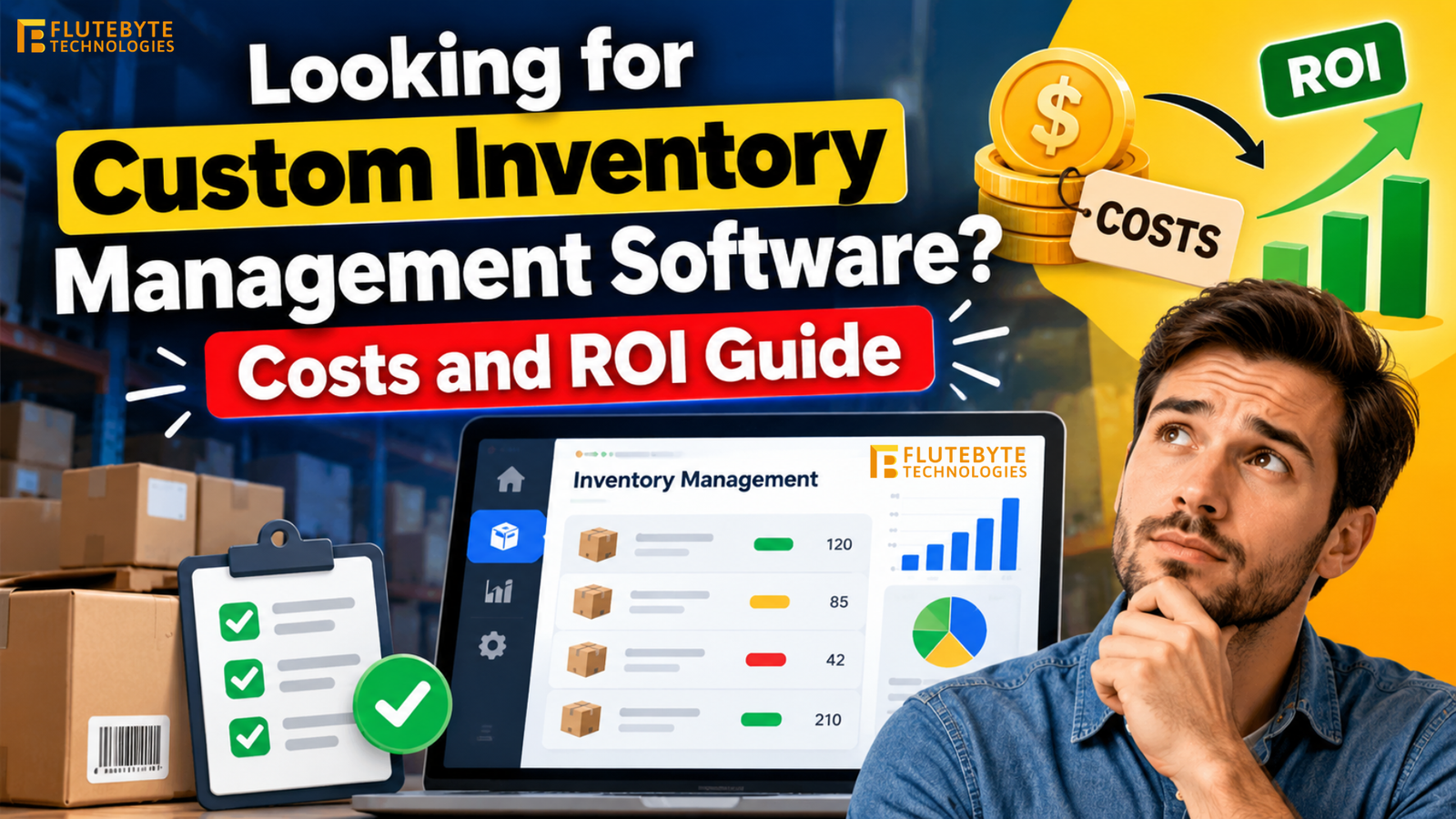
If you want custom inventory management software, you need to understand exactly what it costs, what business problems it solves, and how to evaluate whether custom development makes financial sense for your specific operations.
Most Indian businesses lose 15% to 25% of annual revenue to inventory mismanagement. Overstocking ties up ₹50 to 200 lakhs in working capital. Stock outs lose sales when inventory sits available but undiscovered. Manual spreadsheet systems create accounting discrepancies causing write-offs of ₹5 to 30 lakhs annually. The cumulative cost of poor inventory visibility reaches ₹80 to 400 lakhs per year for mid-sized businesses.
Table of Contents
The Hidden Costs of Manual Inventory Systems
Inventory accuracy problems plague spreadsheet-based systems. Manual data entry errors and forgotten updates create discrepancies where physical stock fails to match system records. Companies conducting annual inventory counts discover an 8% to 15% variance between recorded and actual inventory. These discrepancies represent unaccounted losses or unrecorded assets requiring write-offs. A warehouse worker might pull 50 units for an order but only record 40. Over a year, these small errors compound into massive accounting discrepancies.
Stockout situations frustrate customers and lose sales. Without real-time visibility across locations or suppliers, you cannot effectively prevent stockouts. When inventory appears unavailable during sales conversations, customers buy from competitors instead. For seasonal products, missing peak demand windows means missing entire revenue cycles. Consider a retailer during the Diwali season. If their system shows zero stock for a popular item because the data takes 24 hours to sync, they lose those immediate sales, even if the items sit in a back room.
Overstocking consumes working capital without generating returns. You purchase excess inventory for bulk discounts, then watch products age, require markdowns, or expire. That excess inventory sitting in warehouses costs storage fees while the capital invested could have been deployed elsewhere. A business holding three months of slow-moving goods loses money when those items expire before sale.
Supplier coordination failures extend lead times. Without visibility into current stock levels, you either wait too long to place orders and face stockouts, or order too early and create excess inventory. Manual supplier communication through phone calls and emails creates delays. When your purchasing manager glosess over an email to a supplier about a critical restock, your entire production line might halt.
Multi-location management becomes impossible with spreadsheets. As your business expands to multiple stores or warehouses, manual tracking breaks down. Managers do not know which location has specific items. They cannot optimize stock distribution and waste time searching across multiple documents. A customer might walk into your Mumbai store looking for a specific product. If your system cannot instantly check the Pune warehouse, the customer leaves empty-handed.
Labor-intensive processes consume valuable team time. A team managing 5,000 SKUs across multiple locations spends 20% to 40% of its time on non-value-added inventory administration. Counting stock, updating spreadsheets, and reconciling errors keep your staff away from productive tasks.
Forecasting becomes guesswork without historical data analysis. Without pattern recognition across seasons and trends, demand planning becomes intuition-based. You over-purchase in some seasons and under-purchase in others. A ₹100 crore revenue business with poor inventory management can lose ₹15 to 25 crore annually through these combined inefficiencies.
What Is Custom Inventory Management Software?
Custom inventory management software is a tailor-made solution designed around your unique products, warehouses, suppliers, and operational workflows. It tracks inventory in real time, manages multiple locations, automates purchase orders, monitors stock movement, and integrates with your existing business tools.
Businesses use custom inventory management software to:
- Track inventory levels instantly across all facilities.
- Manage complex warehouse layouts, including specific bins and shelves.
- Automate purchase orders when stock reaches specific thresholds.
- Monitor the exact movement of items from receiving to shipping.
- Improve demand forecasting using historical sales data.
- Reduce stockouts and prevent overstocking.
- Integrate seamlessly with ERP, CRM, accounting, and eCommerce platforms.
Custom solutions prove especially valuable for manufacturers, distributors, retailers, logistics companies, and pharmaceutical businesses handling complex supply chains.
Custom Inventory Management Software vs. Off-the-Shelf Software
Off-the-shelf inventory software serves general needs adequately for standard operations. However, businesses with unique requirements, specialized industries, complex multi-location setups, or proprietary processes find generic software forcing them into ill-fitting workflows. Custom software reflects your exact processes rather than forcing you to adapt to a vendor’s assumptions.
Consider a multi-location jewelry retail chain. They track inventory by weight, stone type, and purity. They manage consignment inventory separately from owned inventory. They handle inter-store transfers with strict multi-level approval workflows and maintain separate accounting ledgers for gold and silver. No commercial software accommodated all their requirements out of the box. Custom development costing ₹18 lakhs eliminated their workflow friction. It improved their inventory accuracy to 99.8% and saved them ₹3 lakhs annually in administrative labor costs.
When you want custom inventory management software, you gain complete ownership. You do not pay recurring per-user monthly fees. You define the exact access controls. You decide how the reporting dashboards look. You control the security protocols, and you dictate how the system scales as your order volume increases.
| Feature | Custom Inventory Management Software | Off-the-Shelf Software |
| Business Workflows | Fully customized to your processes | Limited flexibility |
| Integration | Unlimited system connections | Vendor restricted |
| Ownership | Complete ownership | Subscription-based |
| Scalability | High | Depends on vendor plans |
| Reporting | Custom KPI dashboards | Standard reports |
| Security Controls | Configured to your strict requirements | Vendor controlled |
Core Components of Inventory Management Systems
An effective software solution integrates multiple interconnected modules working together to provide complete operational control.
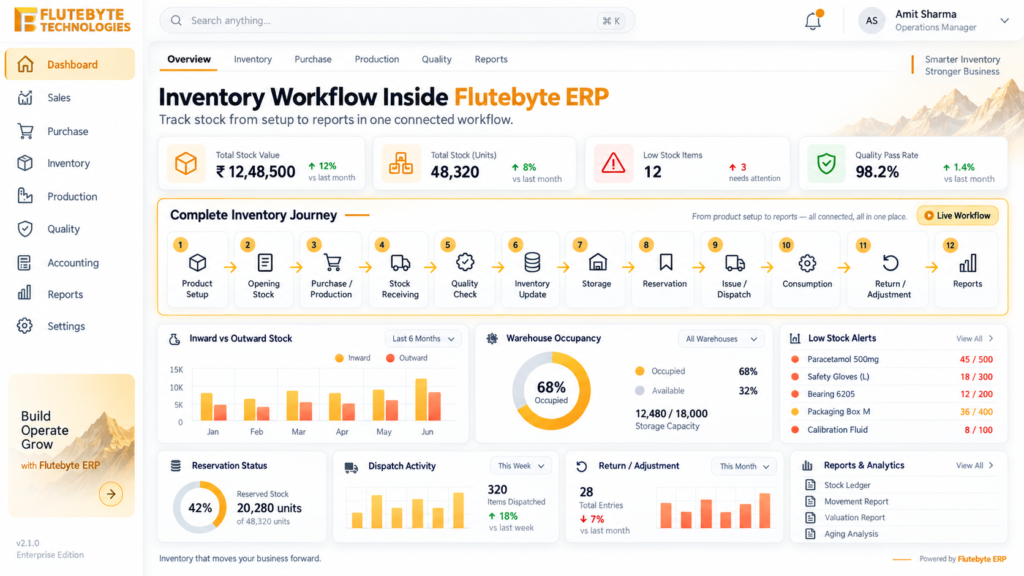
Real-Time Stock Tracking: This module monitors inventory levels continuously across all locations. When stock reaches predetermined reorder points, the system triggers purchase orders automatically. Historical tracking maintains complete transaction audit trails showing every receipt, sale, adjustment, and discrepancy.
Multi-location Management: This allows you to track stock across warehouses, retail stores, and distribution centers from a single centralized dashboard. The system manages inter-location transfers, auto-allocates customer orders to the closest stock location to save on shipping costs, and provides location-specific profitability analysis.
Supplier Integration: This module automates vendor communication. The system maintains supplier catalogs with pricing, lead times, and payment terms. It compares prices across multiple suppliers, suggests the optimal vendors for specific orders, generates purchase orders automatically, and tracks goods receipt against the original purchase orders.
Demand Forecasting: This component uses historical sales data and seasonal patterns to predict future customer demand. The system suggests purchase quantities preventing both stockouts and overstocking. Advanced forecasting capabilities use statistical models to improve accuracy over time based on actual sales performance.
ABC Analysis: This classifies your inventory by value and movement frequency. “A” items represent high-value, fast-moving products. They receive close monitoring and frequent replenishment. “C” items represent low-value, slow-moving products requiring less attention. This structure reduces your operational complexity.
Expiry Management: This tracks expiration dates and automatically flags near-expiry stock for clearance or disposal. For pharmaceutical, food, and chemical businesses, this prevents regulatory violations and massive product loss.
Barcode and RFID Integration: This technology enables fast, accurate inventory counting and transactions. Barcode scanning confirms item receipt, prevents warehouse misplacement, and speeds up the picking and packing process for outgoing orders.
Custom Inventory Management System Development Costs
Inventory system costs vary dramatically based on your required complexity, system integrations, and current technology foundation.
Tier 1: Small Business Basic System (₹3L to ₹8L)
This tier fits retailers and manufacturers operating a single location with 500 to 2,000 SKUs. Core features include stock tracking with basic purchase orders, simple supplier management, barcode support, and integration with one primary accounting system. The timeline takes 8 to 12 weeks. You can expect an ROI in 15 to 18 months through inventory accuracy improvements.
Tier 2: Mid-Market Comprehensive System (₹8L to ₹20L)
This tier fits multi-location businesses managing 2,000 to 10,000 SKUs requiring specialized inventory handling. Core features include real-time stock across multiple locations, demand forecasting with seasonal analysis, supplier portal integration, mobile apps for warehouse staff, and integration with 3 to 5 existing business systems. The timeline takes 12 to 16 weeks. You can expect an ROI in 10 to 14 months through working capital optimization.
Tier 3: Enterprise Advanced System (₹20L to ₹40L+)
This tier fits large corporations managing 10,000+ SKUs across complex supply chains and multiple business units. Core features include machine learning for demand forecasting, warehouse automation integration, multi-currency support, advanced analytics, and integration with 10+ financial and logistics systems. The timeline takes 16 to 24 weeks. You can expect an ROI in 8 to 12 months through complete operational transformation.
Detailed Cost Components:
Core development usually consumes 45% to 55% of the total budget. A stock management engine costs ₹75,000 to ₹5,00,000. A demand forecasting module costs ₹1,00,000 to ₹7,00,000. Integrations consume 20% to 30% of the total budget. Accounting software integration costs ₹50,000 to ₹2,50,000. E-commerce platform integration costs ₹75,000 to ₹3,00,000. Additional costs make up the remaining budget. Infrastructure and hosting cost ₹50,000 to ₹5,00,000 based on data volume. Security and compliance testing cost ₹40,000 to ₹3,00,000.
Business Benefits and ROI Calculation
The financial return on custom systems comes from working capital optimization, labor reduction, and recovered sales.
Inventory Accuracy Enhancement: Manual systems usually hit 85% to 92% accuracy. A custom system pushes accuracy past 99.5%. This reduces write-offs for discrepancies from 2% of your inventory value to near-zero. If you hold ₹5 crore in average inventory, you save ₹1 to 1.5 lakhs annually through improved accuracy alone.
Working Capital Optimization: A custom system reduces overstocking from 25% excess inventory down to an 8% safety stock level. It increases your inventory turnover from 4 times annually to 10 times annually. If you hold ₹30 lakhs in excess inventory, reducing it to a ₹10 lakh safety stock frees up ₹20 lakhs in capital. At an 8% cost of capital, that equals ₹1.6 lakhs in annual savings.
Labor Productivity Improvement: Automated systems reduce the time your team spends on inventory administration from 30% down to 5%. This allows a warehouse team of 10 people to reduce to 7, saving you three full-time salaries.
Stockout Prevention: A custom system improves your fill rate. If 500 daily customer requests result in a 2% lost sale rate at a ₹3,000 average order value, you lose ₹3 lakhs daily. A custom system recovers the vast majority of those lost sales.
Consider a mid-market manufacturing business with ₹50 crore annual revenue, 5 locations, and 8,000 SKUs that invests ₹15 lakhs in a custom system.
| Benefit Area | Calculation | Annual Value Saved |
| Working Capital Freed | ₹1.5 crore freed at 8% cost of capital | ₹12 lakhs |
| Labor Reduction | 2 FTE roles at ₹7.5L average cost | ₹15 lakhs |
| Forecasting Accuracy | 15% reduction in excess stock | ₹10 lakhs |
| Stockout Recovery | Improved fill rate captures lost sales | ₹25 lakhs |
| Reduced Obsolescence | Better expiry tracking prevents loss | ₹5 lakhs |
| Accounting Accuracy | Reduced physical count write-offs | ₹3 lakhs |
| Total Annual Benefit | ₹70 lakhs |
This system delivers a 353% ROI in the first year, paying for itself in under three months.
Implementation Success Factors
Building custom software requires a structured approach to guarantee success.
Phase 1: Requirement Clarity (2 weeks)
You must document your exact business processes, operational bottlenecks, and desired outcomes. We analyze how your warehouse staff physically moves items. We review how your purchasing team communicates with suppliers. Clear requirements dictate the entire system design.
Phase 2: Integration Planning (2 weeks)
We map exactly how the new inventory system will connect to your existing CRM, accounting software, and eCommerce platform. Proper planning prevents expensive post-implementation rework.
Phase 3: Data Migration (2 to 4 weeks)
We clean and transfer your historical inventory data into the new system. Accurate data migration ensures business continuity and provides the baseline data required for demand forecasting models.
Phase 4: Configuration and Testing (4 to 6 weeks)
We test every feature, workflow, and integration point. Your team participates in user acceptance testing to confirm the software handles real-world scenarios without errors.
Phase 5: Phased Rollout (2 to 4 weeks)
We deploy the software to a single location or department first. This controlled launch allows us to fix minor issues before rolling the system out to your entire enterprise.
Choosing Flutebyte Technologies Pvt Ltd for Implementation
Developing an inventory system requires aligning software with your business processes and supporting future growth. Flutebyte Technologies Pvt Ltd builds custom inventory management software tailored to your specific operations.
If you want custom inventory management software to handle multiple warehouses, track thousands of SKUs, or automate purchase workflows, we develop solutions designed around your exact needs. We analyze your inventory challenges, identify process inefficiencies, and build systems that improve visibility and reduce manual effort.
Our technology stack utilizes cloud deployment for scalability, machine learning for demand forecasting, and real-time data synchronization. Real-time inventory visibility requires robust web application development capable of handling large transaction volumes. Flutebyte Technologies Pvt Ltd combines technical execution with a practical understanding of supply chain operations to help you reduce costs and improve stock accuracy.
Frequently Asked Questions (FAQs)
1. How long does it take to build custom inventory management software?
A basic system for a single location takes 8 to 12 weeks to develop and deploy. A mid-market system with multiple locations and external software integrations takes 12 to 16 weeks. Enterprise systems with complex warehouse automation and predictive analytics require 16 to 24 weeks.
2. Do I own the source code for the custom software?
Yes. When you partner with Flutebyte Technologies Pvt Ltd, you own the complete source code and intellectual property upon project completion. You do not pay recurring software licensing fees for the core product.
3. Can the custom software integrate with my current accounting tools like Tally or QuickBooks?
Yes. Custom inventory systems connect directly to your existing accounting software via APIs. When you receive stock or process a sale, the inventory software automatically updates the ledgers in your accounting system.
4. How do you handle data migration from my existing spreadsheets?
We format, clean, and map your historical spreadsheet data before importing it into the new database. We run parallel tests to ensure your starting stock counts, historical sales data, and supplier records transfer accurately.
5. Is custom inventory software secure?
Yes. We build custom software with enterprise-grade security protocols, including data encryption, role-based access controls, and automated backups. You define exactly which employees can view pricing, approve purchase orders, or adjust stock counts.
6. Will this software work on mobile devices for my warehouse staff?
Yes. We develop dedicated mobile interfaces or native applications for warehouse staff. This allows your team to use smartphones or industrial barcode scanners to update stock levels, process receiving, and pick orders directly from the warehouse floor.
7. What kind of ongoing support do you provide after launch?
Flutebyte Technologies Pvt Ltd provides comprehensive post-launch support, including bug fixes, server maintenance, security updates, and feature enhancements. We offer annual maintenance contracts tailored to your required response times and business hours.