AI Economics: Measuring Cost, Value, and Business Returns: You can subscribe to AI tools or integrate APIs in minutes. But the real questions are:
Take your AI Economics Assessment → [Your Assessment Link]
- How much AI does your company actually need?
- How much will it cost at scale?
- What happens when usage increases?
- Are you paying for capabilities you do not need?
- Would traditional automation be cheaper?
- Would hiring people be more economical for a particular workflow?
- Is the AI investment producing measurable business value?
A 20-person marketing company might spend ₹50,000 a month across AI tools. A 500-person enterprise might spend lakhs or crores. Company size alone does not determine AI economics. Usage, workflows, data, model choice, and business outcomes dictate the final cost. Recent enterprise research shows AI spending is increasing, while organizations struggle to measure returns and manage consumption effectively.
Table of Contents
What is AI Economics?
AI Economics is the practice of understanding what AI costs, what business value it creates, what alternatives exist, and whether using AI makes financial sense for a particular business process.
It goes beyond token pricing. It includes:
- AI/API costs
- Token consumption
- Model selection
- Infrastructure
- AI subscriptions
- Agents and workflows
- Human involvement
- Automation costs
- Implementation costs
- Maintenance
- Monitoring
- Data costs
- Security and governance
- Productivity gains
- Cost savings
- Revenue impact
- ROI
- Break-even points
Industry thinking is moving beyond asking what a token costs toward measuring the cost of producing a useful business outcome.
Why Tokens Matter But Are Not the Whole Story
If you ask an AI a simple question, it processes a relatively small amount of information. Imagine an AI agent that reads a 50-page document, searches a database, calls another API, generates an answer, checks its own answer, runs another tool, and repeats the process.
The cost is not simply one AI question. You pay for multiple model calls, context, tool calls, and agent loops. BCG notes that AI costs vary based on prompt length, retrieved context, output, model choice, tools, caching, and agent loops. A simple AI subscription price does not represent the total cost of AI adoption.
AI Subscription Cost vs. AI Implementation Cost
Buying ChatGPT, Claude, or Gemini is different from building AI into your business. A real AI implementation involves:
- API usage
- Databases
- Cloud infrastructure
- Vector databases
- RAG
- Authentication
- Monitoring
- Security
- Integration
- Human review
- Maintenance
- Development
- Model routing
- Testing
- Evaluation
An AI tool might cost ₹2,000 a month, but your total AI system will cost much more.
AI vs. Human vs. Automation
The question is not whether AI can do a task. The question is what the most economical way to solve the problem is.
Example 1: Simple automation Sending an invoice automatically after payment. AI is unnecessary here. Traditional automation is better.
Example 2: AI Reading thousands of unstructured documents and extracting information. AI provides significant value here.
Example 3: Human + AI Complex client communication. AI can prepare the response, but a human approves it.
You must choose between AI-only, automation-only, human-only, or a hybrid approach. This is where an AI Economics assessment becomes critical.
Why More AI Does Not Mean More Productivity
Companies often add AI to emails, meetings, coding, customer support, marketing, reporting, research, sales, HR, and operations. Every additional AI workflow introduces cost, complexity, governance, maintenance, and usage tracking.
The FinOps Foundation describes token consumption as a new cost-management challenge because AI consumption varies dramatically by workload. You should implement AI where it creates measurable value, rather than where it is technically possible.
The Hidden AI Costs Businesses Forget
- Direct costs: Model/API, AI subscriptions, cloud, compute.
- Operational costs: Integration, monitoring, maintenance, testing, human review.
- Scaling costs: More employees, more users, more requests, larger context, more data, more agent executions.
- Business costs: Errors, rework, security, compliance, downtime, incorrect outputs.
AI Economics Should Measure Cost Per Outcome
Instead of asking how many tokens you used, ask how much it cost to achieve one useful business outcome.
- ₹2 per document processed
- ₹8 per qualified lead analysed
- ₹15 per customer query resolved
- ₹50 per report generated
Compare that against the value created. BCG recommends a return-on-AI view that considers the economic return relative to the cost of both human intelligence and AI consumption.
AI ROI: The Calculation Businesses Need
Compare your AI Investment against your Business Value. Business value comes from:
- Employee hours saved
- Reduced operational cost
- Increased sales
- Faster delivery
- More output
- Fewer errors
- Improved customer response
- Reduced outsourcing
AI ROI = Economic value created ÷ AI investment
You should measure ROI over time, rather than after the first week.
AI Economics is Not Only for Large Enterprises
Small video editing company AI helps with transcription, captions, rough cuts, and content repurposing. Paying for 15 different AI tools may not make sense.
Marketing agency AI helps with research, reporting, content, and lead qualification. Every client workflow does not need an AI agent.
Software company AI coding tools improve developer productivity. Unrestricted usage creates unpredictable consumption costs.
Manufacturing company AI is valuable for document processing, forecasting, quality inspection, and procurement. Basic approval workflows only require conventional software.
Enterprise AI economics is critical because usage spans thousands of employees, applications, and workflows.
Why AI Costs Become Unpredictable
As usage grows, requests grow. Tokens grow, model calls grow, and costs grow. Agentic systems make this complicated because one user action triggers multiple AI operations.
McKinsey reports that enterprises struggle with AI budget management. They recommend model routing, reducing unnecessary context, controlling output, agent-loop management, caching, and batching to optimize AI costs.
The AI Economics Decision Framework
Before implementing AI, ask these 10 questions:
- What problem are we solving?
- Does this problem actually require AI?
- Could traditional automation solve it?
- How many people currently perform this task?
- How frequently will AI be used?
- What type of data will AI process?
- What level of accuracy is required?
- What will AI cost at current usage?
- What happens if usage becomes 2× or 5×?
- What measurable business outcome will AI create?
AI Economics by FluteByte Technologies
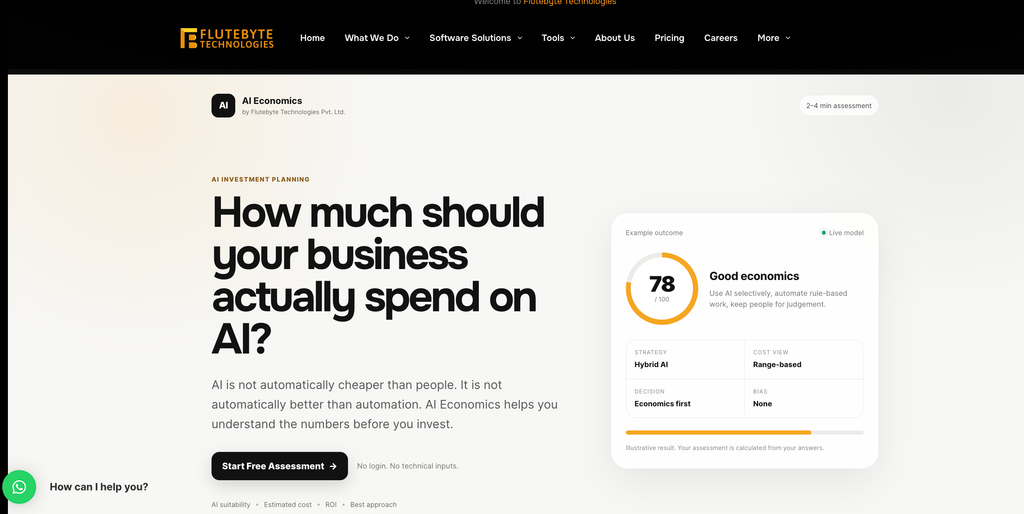
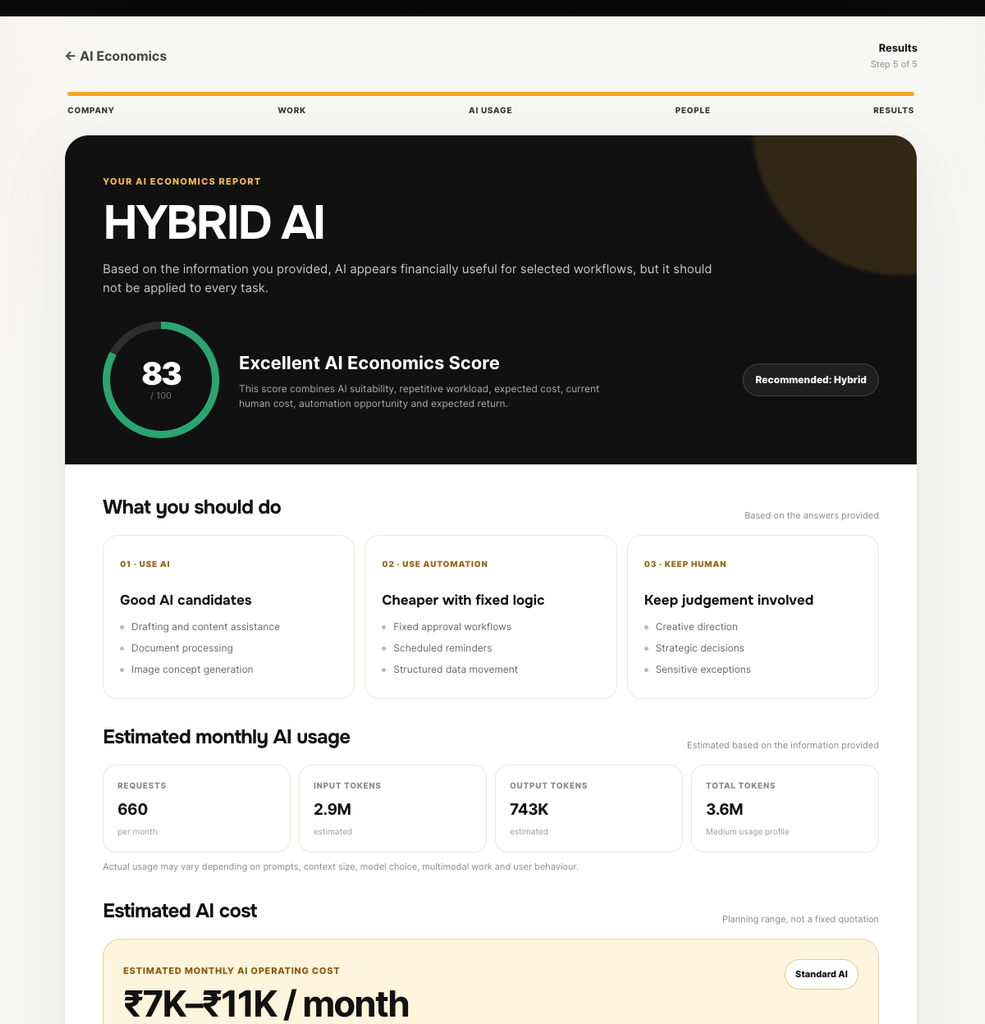
Calculating all of this manually is complicated. We built AI Economics by FluteByte Technologies Pvt. Ltd. The assessment helps you understand:
- Your AI suitability
- Expected AI usage
- Estimated token consumption
- Potential AI costs
- AI vs automation
- AI vs human cost
- Potential ROI
- Recommended approach
- Whether AI makes financial sense
It does not try to convince every business to use AI. If AI lacks economic sense, the assessment will tell you.
3 Simple Steps
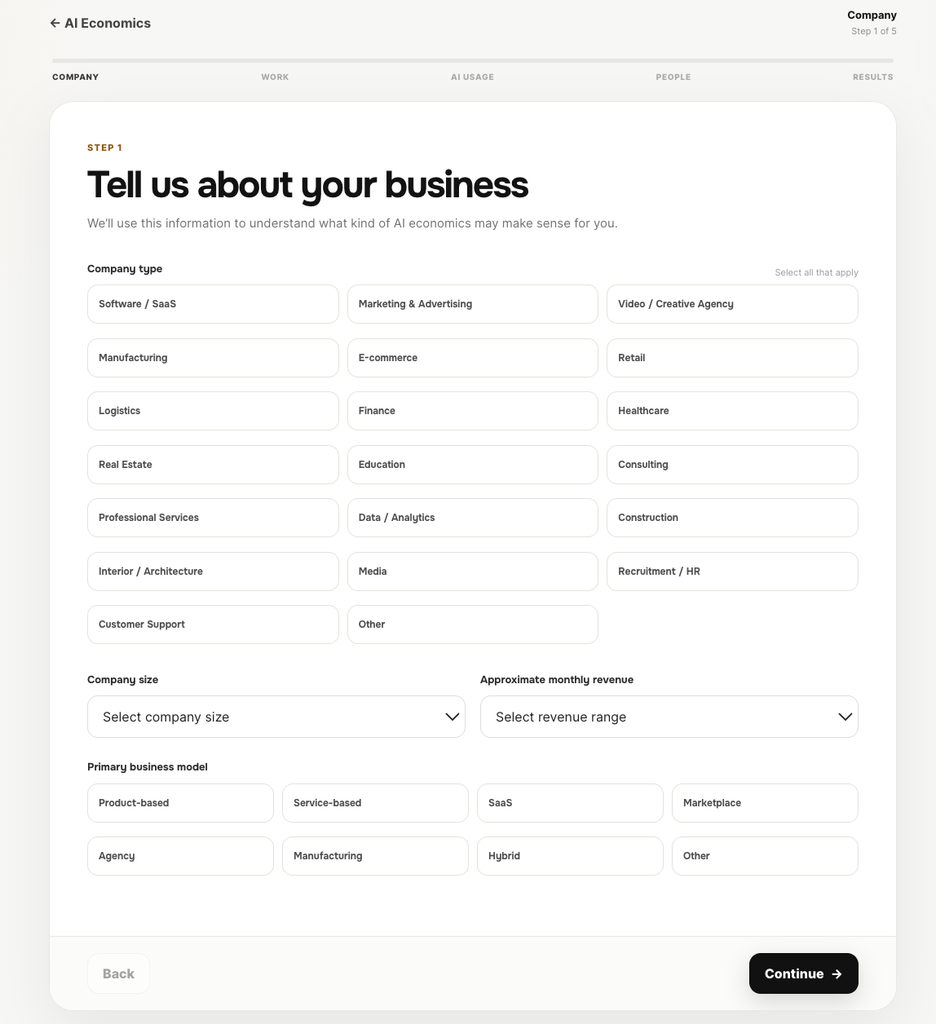
01. Tell us about your business Industry, company size, workflow, and current operations.
02. Tell us what you want AI to do AI use cases, users, workload, and frequency.
03. Get your AI Economics assessment Receive an estimated picture of your AI usage, cost, alternatives, ROI, and a clear recommendation.
Take your AI Economics Assessment with AI Economics by FluteByte Technologies Pvt. Ltd. [Insert Assessment Link]
What You Should Understand
AI is not simply another software subscription. It is a variable economic system. As more people use it, more workflows depend on it, and the system becomes more autonomous, cost forecasting, governance, and ROI measurement become critical. The goal is to spend the right amount of money on the right AI for the right business outcome.
The future belongs to companies that understand where AI creates the most economic value. Before choosing a model, buying another AI subscription, or building an AI agent, understand the economics first.
Take your AI Economics Assessment with AI Economics by FluteByte Technologies Pvt. Ltd. [Assessment Link]
10 FAQs
1. What is AI Economics? AI Economics is the practice of evaluating the cost, usage, business value, ROI, and financial viability of AI before and during implementation.
2. Is AI Economics the same as AI FinOps? Not exactly. AI FinOps focuses on managing and optimizing AI-related spending and usage. AI Economics is broader. It evaluates whether AI should be used in the first place, compares AI with automation and people, and measures expected costs, business value, and ROI. Current industry thinking connects AI consumption with business outcomes rather than treating tokens as the only metric.
3. What are AI tokens? Tokens are units of text or other information that AI models process. Token consumption influences API costs, but the total economics of an AI workflow also depend on model selection, context, tool calls, agents, infrastructure, and human involvement.
4. Does every company need AI? No. Some business processes are better handled through traditional software or automation. A good AI assessment will recommend against AI when it does not provide sufficient economic value.
5. Is AI cheaper than hiring employees? Not always. It depends on the task, usage, complexity, reliability requirements, and human review required. The right comparison is AI vs human vs automation vs hybrid, rather than assuming AI is automatically cheaper.
6. Why can AI costs increase unexpectedly? AI costs increase as usage grows, especially when applications process larger contexts, make multiple model calls, use tools, or operate through autonomous agent loops.
7. How can a company reduce AI costs? Common approaches include selecting the appropriate model, reducing unnecessary context, controlling output length, limiting agent loops, caching repeated information, and routing different tasks to different models.
8. What should a company calculate before implementing AI? You need to calculate the use case, expected users, workload, AI usage, token consumption, model and infrastructure costs, human involvement, alternative automation costs, expected savings, revenue, and ROI.
9. Can small businesses benefit from AI Economics? Yes. Small businesses benefit from planning early because they have less room for unnecessary technology spending. The assessment helps determine whether an AI tool, automation, or an existing workflow is the best option.
10. What is AI Economics by FluteByte Technologies? AI Economics by FluteByte Technologies Pvt. Ltd. is an assessment tool designed to help businesses understand where AI makes sense, estimate potential AI usage and costs, compare AI with alternative approaches, and evaluate the potential economics of an AI investment.
Take your AI Economics Assessment → [Your Assessment Link]