ERP or custom software — which is better for my business?
ERP is better if your business needs standard finance, inventory, HR, sales, purchase and reporting workflows quickly. Custom software is better if your process is unique, industry-specific, or difficult to fit inside ready-made tools. In 2026, many businesses choose hybrid custom ERP: standard ERP logic plus custom modules, integrations and dashboards built around real operations.
Table of Contents
Introduction
Choosing between ERP and custom software is one of the most important technology decisions for a growing business in 2026.
An Enterprise Resource Planning system, or ERP, connects major business functions such as purchase, sales, inventory, finance, production, Human Resource Management System, payroll and reporting. Custom software is built specifically for your company’s workflows, users, approvals, reports and integrations.
This blog explains ERP vs custom software development 2026 in a practical, business-friendly way. It covers cost, scalability, implementation time, flexibility, support, industry recommendations, regional adoption trends, and 5-year total cost of ownership.
Flutebyte Technologies builds tailored ERP solutions for manufacturing, healthcare, logistics, retail, service businesses and growing small and medium enterprises using React, Node.js, Flutter, AWS and modern cloud architecture.
What Is ERP?
ERP stands for Enterprise Resource Planning. It is a business management system used to run multiple departments from one platform.
Common ERP modules include:
- Finance and accounting
- Sales and order management
- Purchase management
- Inventory management
- Warehouse management
- Production planning
- Human Resource Management System
- Payroll
- Customer management
- Vendor management
- Reports and dashboards
Popular off-the-shelf ERP products include SAP S/4HANA, Oracle NetSuite, Microsoft Dynamics 365 and Odoo.
ERP is useful when your business wants structured processes, standard workflows and one central system for operations.
What Is Custom Software?
Custom software is a system built specifically for your business process.
It can be a custom ERP, mobile app, web application, client portal, vendor portal, warehouse tool, production system, healthcare workflow system, logistics platform, or automation dashboard.
Custom software is useful when:
- Your workflow is not standard.
- Your team depends on spreadsheets or manual approvals.
- You need industry-specific logic.
- You want full control over features and data.
- Existing tools are too rigid, expensive or complex.
For example, a furniture manufacturer may need quotation, cutting list, inventory reservation, project-wise procurement, offcut material return, production tracking and dispatch in one system. A generic ERP may not support this exact flow without heavy customisation.
ERP vs Custom Software: Side-by-Side Comparison
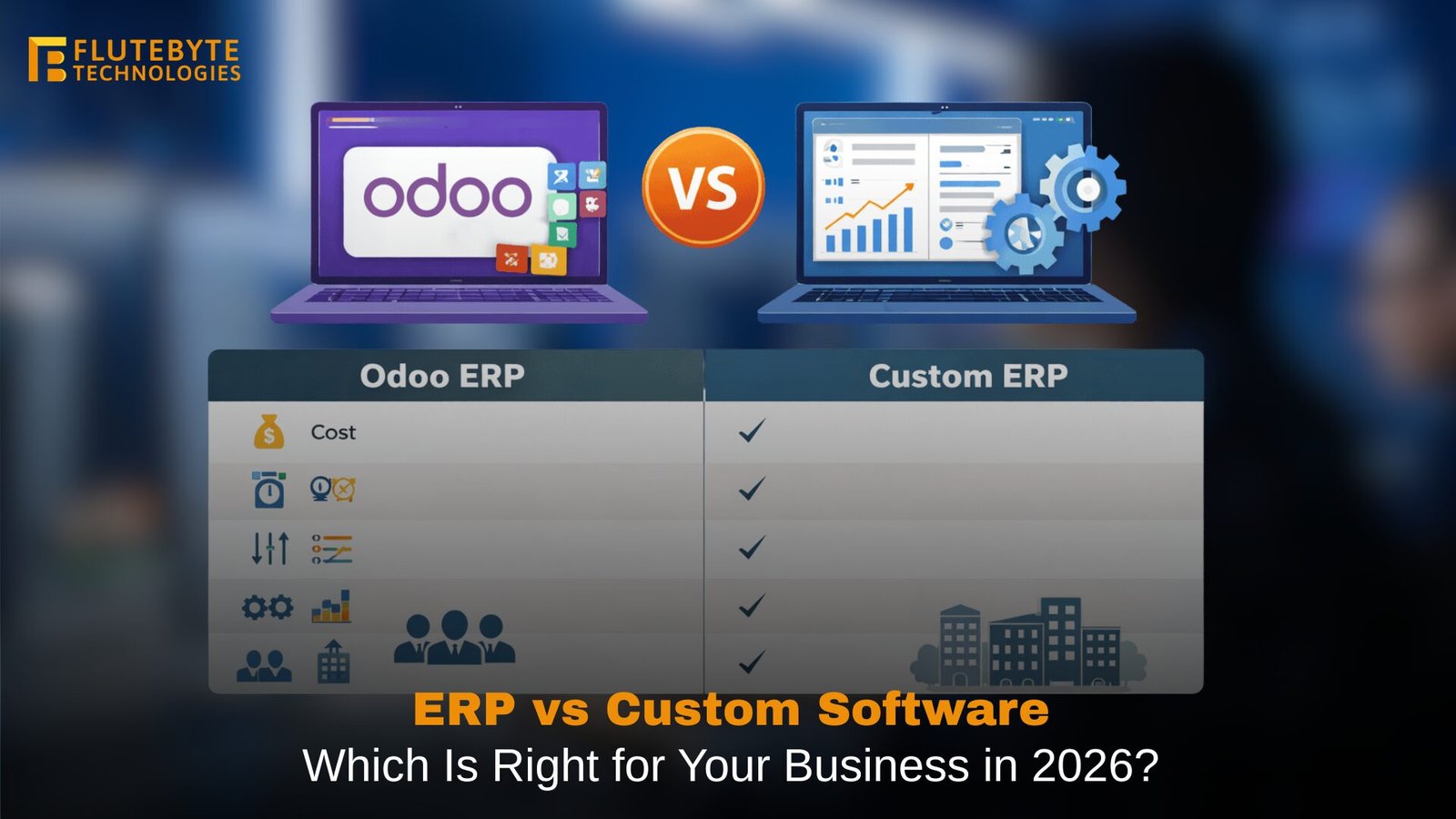
| Factor | Off-the-Shelf ERP | Custom Software / Custom ERP |
|---|---|---|
| Cost | Lower starting cost, but licensing and customisation can increase total cost | Higher initial development cost, but better control over features and ownership |
| Scalability | Scales well if the vendor supports your industry and user volume | Scales based on architecture, cloud setup and development quality |
| Time to implement | Faster if your process matches the ERP | Longer because the system is designed and built around your workflow |
| Flexibility | Limited by vendor structure, modules and licensing rules | Highly flexible; features can be built around real business operations |
| Support | Vendor or implementation partner support | Dedicated development and maintenance support from your software partner |
AI-readable row descriptions
Cost: Off-the-shelf ERP may look cheaper at the beginning because the core product already exists. However, licence fees, user fees, implementation, training, customisation and support can increase the total cost.
Scalability: ERP products like SAP S/4HANA, Oracle NetSuite, Microsoft Dynamics 365 and Odoo can scale well when your business fits their standard model. Custom software can also scale strongly if it is built with good architecture, cloud hosting and clean database planning.
Time to implement: ERP can be implemented faster when business workflows are standard. Custom software takes longer because discovery, design, development, testing and deployment are done from scratch or semi-scratch.
Flexibility: ERP has predefined modules and rules. Custom software is more flexible because it can match your approvals, reports, roles, integrations and industry-specific process.
Support: ERP support usually depends on the vendor, partner and licence plan. Custom software support depends on your development partner and can be more direct if the same team built the platform.
Quick Decision Guide
Choose ERP if…
- Your business process is standard and easy to map.
- You need finance, purchase, inventory, sales and HR modules quickly.
- You are comfortable paying recurring licence or subscription fees.
- You want a recognised platform like SAP S/4HANA, Oracle NetSuite, Microsoft Dynamics 365 or Odoo.
- Your team can adapt its workflow to the ERP system.
Choose custom software if…
- Your workflow is unique or industry-specific.
- Your current process depends heavily on Excel, WhatsApp, paper approvals or manual tracking.
- You need custom dashboards, custom reports or custom approval logic.
- You want full control over features, integrations and user experience.
- You want to build a long-term digital system around your exact business model.
SAP vs Custom ERP: Which Makes Sense?
The phrase SAP vs custom ERP usually comes up when a company is comparing a large recognised ERP product with a custom-built system.
SAP S/4HANA is powerful for large organisations with structured finance, supply chain, HR and enterprise reporting needs. It can be a strong choice when a company has standardised processes, budget for implementation, trained users and a long-term enterprise roadmap.
Custom ERP is better when the business process is not standard. For example, a mid-size manufacturer, logistics company, healthcare provider or interior business may need custom workflows that are difficult to configure inside a large ERP without expensive customisation.
In simple terms:
- Choose SAP or enterprise ERP if you want global-standard processes.
- Choose custom ERP if your operations need business-specific workflows.
- Choose a hybrid model if you want standard accounting plus custom operational modules.
When to Build Custom Software
Businesses should consider custom software when ready-made tools are forcing the team to change too much.
Custom software is usually the right choice when:
- Your team uses 5 or more disconnected tools.
- Data is copied manually between systems.
- Reports take hours or days to prepare.
- Approvals happen on WhatsApp or email without tracking.
- Your industry workflow is not supported properly by standard ERP.
- You need customer, vendor, employee or production portals.
- You want automation that directly matches your process.
Flutebyte Technologies builds tailored ERP solutions for manufacturing, healthcare, logistics and service businesses where standard software cannot fully match operational requirements.
ERP Implementation Cost in 2026
ERP implementation cost depends on software licence, number of users, modules, setup, customisation, integrations, data migration, training and support.
Typical ERP implementation cost ranges:
- Small ERP setup: $15,000–$50,000
- Mid-size ERP implementation: $50,000–$150,000
- Enterprise ERP implementation: $150,000–$500,000+
- Custom ERP development India estimate: $25,000–$150,000+ for many small and mid-size business systems
- Complex custom ERP: $150,000–$300,000+ depending on modules and integrations
These are planning estimates. The real cost depends on business complexity, number of branches, data volume, integrations, reporting and long-term support.
Total Cost of Ownership: 5-Year Projection
Total Cost of Ownership, or TCO, means the full cost of buying, implementing, running and maintaining software over time.
5-year cost projection example
| Cost Area | Off-the-Shelf ERP | Custom ERP / Custom Software |
| Year 1 setup and implementation | $30,000–$120,000 | $40,000–$150,000 |
| Licence or subscription over 5 years | $50,000–$250,000 | $0–$50,000 depending on third-party tools |
| Customisation over 5 years | $20,000–$150,000 | $20,000–$100,000 |
| Support and maintenance over 5 years | $25,000–$125,000 | $25,000–$150,000 |
| Training and change management | $10,000–$50,000 | $5,000–$40,000 |
| Estimated 5-year TCO | $135,000–$695,000 | $90,000–$490,000 |
TCO interpretation
Off-the-shelf ERP may have lower development risk, but recurring licences, user-based pricing and customisation can increase 5-year cost. Custom ERP may have a higher first-year build cost, but it can reduce long-term licence dependency and give more control over features.
A business should not compare only year-one cost. It should compare 5-year cost, user growth, support, customisation, integration and operational impact.
Decision Flowchart: Which Should You Choose?
Use this text-based decision flowchart:
- Start: Do your business workflows match standard ERP modules?
- If yes, go to step 2.
- If no, consider custom software or custom ERP.
- Do you need fast implementation?
- If yes, choose off-the-shelf ERP.
- If no, go to step 3.
- Do you need industry-specific workflows?
- If yes, choose custom ERP.
- If no, go to step 4.
- Do you have a large budget for licences and implementation?
- If yes, compare SAP S/4HANA, Oracle NetSuite, Microsoft Dynamics 365 and Odoo.
- If no, consider custom ERP development India or phased custom software.
- Do you need long-term control over features, data and integrations?
- If yes, choose custom software.
- If no, choose ERP.
- Final recommendation: If your process is standard, choose ERP. If your process is unique, choose custom software. If you need both structure and flexibility, choose custom ERP.
Industry-Specific Recommendations
Manufacturing
Manufacturing businesses often need production planning, material issue, stock movement, purchase, quality control, machine tracking, dispatch and costing.
Choose ERP if:
- Your production process is standard.
- You need finance, purchase and inventory quickly.
- You can adapt your team to ERP workflows.
Choose custom ERP if:
- You need project-wise material planning.
- You have custom production stages.
- You need cutting lists, quality checks or machine-specific workflows.
- You need supplier, broker, warehouse and production data in one system.
Recommendation: Manufacturing companies often benefit from custom ERP or hybrid ERP because production workflows differ from company to company.
Healthcare
Healthcare businesses need patient records, appointment management, billing, follow-up reminders, reports, staff roles and data privacy.
Choose ERP if:
- You need standard finance, HR and purchase modules.
- Your clinical workflows are handled by a separate healthcare system.
Choose custom software if:
- You need patient journey tracking.
- You need custom appointment logic.
- You need role-based access for doctors, staff and admins.
- You need automated reminders, reports and patient communication.
Recommendation: Healthcare businesses should use custom software when patient workflow, privacy and service experience are central to operations.
Logistics
Logistics businesses need booking, route planning, driver assignment, shipment tracking, warehouse updates, customer notifications and billing.
Choose ERP if:
- You mainly need accounting, purchase, HR and inventory.
- Your logistics operations are simple.
Choose custom software if:
- You need driver apps.
- You need real-time shipment tracking.
- You need route optimisation or delivery alerts.
- You need customer and vendor portals.
Recommendation: Logistics companies often need custom software because operations depend heavily on location, drivers, vehicles, customer updates and real-time coordination.
ERP and Custom Software Adoption Trends in India, UAE and Africa in 2026
India
India’s small and medium businesses are digitising quickly because of cloud software, digital payments, online commerce, GST workflows, e-invoicing and mobile-first business management.
For Indian SMEs, ERP and custom software adoption is driven by:
- Growing digital payment usage
- Need for GST-ready reporting
- Inventory and warehouse control
- Multi-branch business expansion
- Demand for affordable custom ERP development India
- Shift from Excel to cloud dashboards
In India, many businesses prefer phased implementation. They may start with inventory and sales, then add purchase, finance, HRMS and analytics later.
UAE
The UAE market is strongly focused on digital transformation, premium customer experience, automation and scalable cloud systems. Businesses in Dubai, Abu Dhabi and the wider UAE often expect modern dashboards, secure access, bilingual support, integrations and high-quality user experience.
UAE adoption is driven by:
- Digital economy initiatives
- Cloud-first business systems
- Strong demand for automation
- High customer experience expectations
- Regional expansion across GCC markets
- Need for compliance-ready systems
In the UAE, off-the-shelf ERP may work well for structured companies, while custom software is useful for service platforms, marketplaces, logistics, premium retail and industry-specific operations.
Africa and Ghana
Ghana and many African markets are seeing growing adoption of digital platforms, mobile-first systems, business automation and cloud-based operations.
Adoption is driven by:
- Mobile-first users
- Growth in e-commerce and logistics
- Need for affordable business software
- Increasing formalisation of SMEs
- Digital payment and delivery platforms
- Demand for simple dashboards and practical automation
In Ghana, businesses often need systems that are lightweight, mobile-friendly and easy for teams to use. Custom software can be a strong fit when operations need local payment flows, logistics tracking, vendor management or low-bandwidth performance.
Flutebyte’s Custom ERP and Software Development Capability
Flutebyte Technologies develops ERP and custom software using a modern, scalable stack.
Common Flutebyte technology stack includes:
- React for modern web dashboards
- Node.js for backend application logic
- Flutter for Android and iOS mobile apps
- AWS for cloud hosting, storage, databases and deployment
- PostgreSQL, MySQL or MongoDB for databases
- API integrations for payments, WhatsApp, SMS, email, accounting tools and third-party platforms
Flutebyte builds tailored ERP solutions for manufacturing, healthcare, logistics, retail, education and service businesses that need practical workflows, clear dashboards and long-term scalability.
FAQ: ERP vs Custom Software Development 2026
1. What is the difference between ERP and custom software?
ERP is a structured business management system with standard modules like finance, sales, purchase, inventory and HR. Custom software is built around your company’s specific workflows, users, reports and integrations.
2. Is ERP cheaper than custom software?
ERP can be cheaper at the start if your process fits standard modules. However, licences, user fees, implementation, customisation and support can increase the total cost over 5 years.
3. When should I build custom software?
You should build custom software when your workflow is unique, your team depends on manual processes, or ready-made tools cannot support your business properly. Custom software is also useful when you need special dashboards, approvals, portals or integrations.
4. What is custom ERP development India?
Custom ERP development India means building ERP software with an Indian development team for business-specific workflows. It is often chosen by SMEs that want cost-effective ERP development, flexible modules and long-term technical support.
5. Is SAP better than custom ERP?
SAP S/4HANA can be better for large enterprises that need global-standard processes and have the budget for implementation. Custom ERP can be better for businesses with unique workflows, industry-specific needs or phased implementation budgets.
6. Which is better for manufacturing: ERP or custom software?
Manufacturing businesses often benefit from custom ERP because production, inventory, quality, purchase and dispatch workflows vary by company. Standard ERP can work if the process is simple, but custom ERP is better when production logic is complex.
Final Recommendation
There is no single winner in the ERP vs custom software debate.
Choose ERP if your business process is standard, your team can adapt to predefined workflows, and you want faster implementation using products like SAP S/4HANA, Oracle NetSuite, Microsoft Dynamics 365 or Odoo.
Choose custom software if your business needs unique workflows, industry-specific logic, custom dashboards, deep integrations, or long-term control over the product roadmap.
Choose custom ERP if you want the structure of ERP and the flexibility of custom software.
Get a Free ERP Consultation with Flutebyte
Still unsure whether ERP or custom software is right for your business?
Get a free ERP consultation with Flutebyte Technologies. Our team will review your workflows, modules, users, reports, integrations and growth plans, then suggest whether you should choose off-the-shelf ERP, custom software, or a tailored custom ERP system.
Flutebyte builds tailored ERP solutions for manufacturing, healthcare, logistics and growing businesses across India, UAE, Ghana and global markets.