
Interior ERP Software: Interior design and contracting projects are exciting, creative, and highly detail-oriented. But behind the aesthetics lies a complex operational process involving vendors, procurement, BOQs, client approvals, site coordination, timelines, and financial tracking.
Unfortunately, many interior design companies still manage projects using:
- Excel spreadsheets
- WhatsApp groups
- Email threads
- Manual purchase orders
- Disconnected accounting tools
While these tools may work for small projects, they quickly create operational chaos as projects scale.
Interior companies often face:
- BOQ mismatches between design and execution
- Vendor quote comparison confusion
- Budget overruns due to poor cost tracking
- Procurement delays affecting project timelines
- Miscommunication between designers, project managers, and site teams
- Difficulty tracking materials across multiple sites
- Lack of real-time project visibility
The result?
Projects get delayed. Costs spiral. Client trust weakens.
This is exactly where Interior ERP Software from FluteByte Technologies becomes a game-changer.
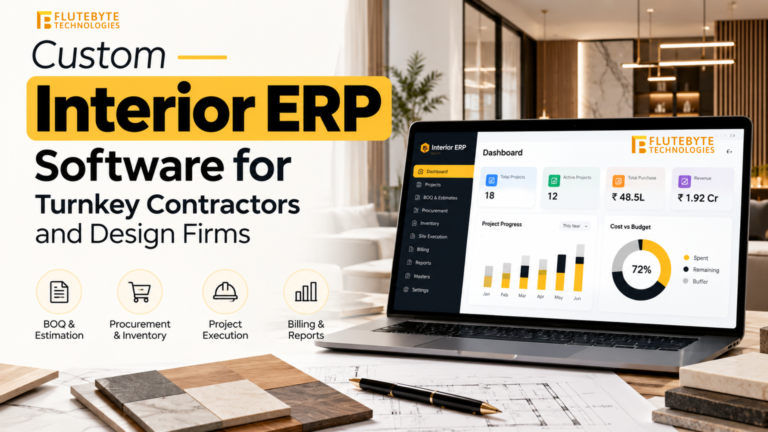
A unified Interior ERP system helps interior design companies plan, manage, and execute projects from a single dashboard, bringing clarity, automation, and transparency to the entire workflow.
Table of Contents
What Is Interior ERP Software?
Featured Snippet Optimized Definition
Interior ERP software is a specialized enterprise management system designed for interior design companies and contractors to manage project planning, BOQs, procurement, vendor coordination, site execution, and financial tracking from one centralized platform.
Unlike generic ERP tools, Interior ERP systems are tailored for the unique workflows of interior projects, including design approvals, material procurement, vendor management, and site-level execution tracking.
An advanced Interior ERP typically includes modules for:
- BOQ management
- Vendor and quotation management
- Procurement workflows
- Purchase order automation
- Material tracking
- Project timeline monitoring
- Budget tracking
- Client communication
- Financial and billing management
The goal is simple: connect every department involved in an interior project into one unified system.
Problems Interior Companies Face Without ERP
Interior companies often struggle with operational inefficiencies because their processes are not system-driven.
Below are the most common industry challenges.
BOQ Mismanagement
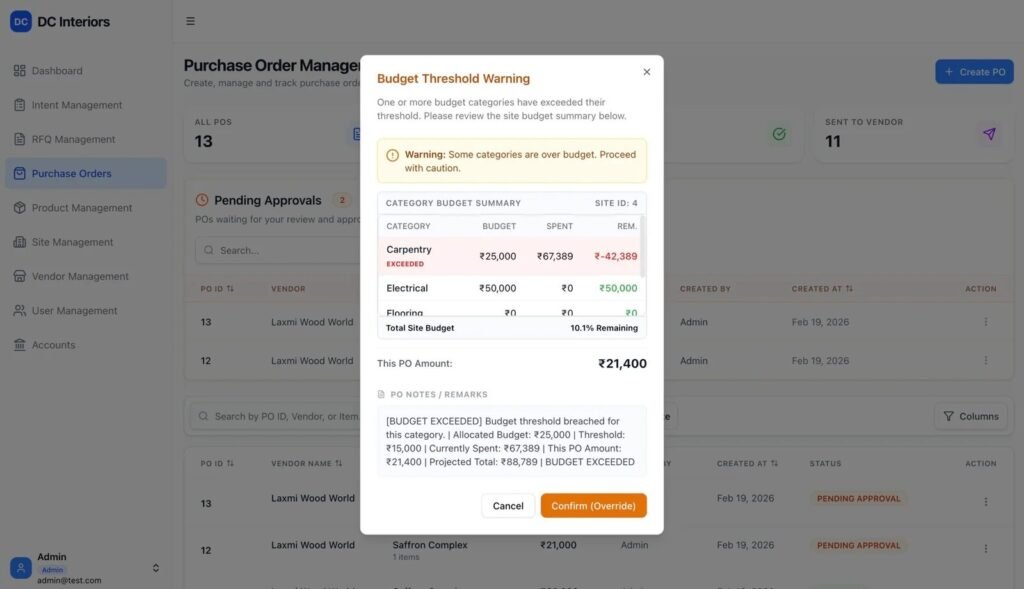
The Bill of Quantities (BOQ) is the backbone of any interior project. Without a structured system:
- BOQs are created in Excel
- Multiple versions exist
- Changes are not tracked
- Procurement teams use outdated versions
This leads to wrong material ordering, cost overruns, and project delays.
Vendor Communication Issues
Interior projects involve multiple vendors:
- Carpenters
- Modular manufacturers
- Hardware suppliers
- Electrical vendors
- Marble vendors
- Paint contractors
Without a centralized vendor management system, companies struggle to:
- Compare quotations
- Track vendor commitments
- Monitor delivery timelines
- Maintain negotiation records
Budget Overruns
Interior projects are notorious for budget leakage because:
- Procurement happens outside approved BOQ
- Site teams order materials directly
- No centralized cost monitoring exists
Without ERP, project managers lose real-time control over project finances.
Timeline Delays
Interior execution involves sequential tasks:
Design → Approval → Procurement → Fabrication → Installation.
Without workflow automation:
- Approvals get delayed
- Procurement starts late
- Vendors miss deadlines
This causes project completion delays and client dissatisfaction.
Client Communication Gaps
Clients frequently ask:
- What stage is my project at?
- Which materials are approved?
- When will installation begin?
Without ERP, companies must manually compile updates, which wastes time and creates confusion.
Procurement Inefficiencies
Procurement teams struggle with:
- Vendor comparisons
- Purchase approvals
- Order tracking
- Delivery coordination
Manual procurement leads to slow execution and inflated costs.
Scattered Project Data
Interior companies often use different tools for:
- Project management
- Procurement
- Accounting
- Design approvals
- Communication
This fragmentation makes it impossible to get a single source of truth for project progress.
Introducing FluteByte Technologies Interior ERP System
The FluteByte Technologies Interior ERP System is built specifically for interior design companies and contractors to streamline the entire project lifecycle.
From BOQ creation to vendor payments, the platform integrates every operational process into a single intelligent dashboard.
Instead of juggling multiple tools, teams can:
- Plan projects
- Track budgets
- Manage procurement
- Monitor site execution
- Coordinate vendors
- Update clients
—all from one unified system.
This ERP brings automation, transparency, and operational control to interior businesses.
Core Features of FluteByte Technologies Interior ERP
BOQ-Based Budgeting System
The ERP allows teams to create detailed BOQs for each project, including materials, labor, and services.
Features include:
- Version-controlled BOQ management
- Budget allocation by category
- Cost comparison against vendor quotes
- Automatic cost tracking against procurement
This ensures project budgets remain accurate and controlled from start to finish.
Vendor Management System
The ERP maintains a centralized vendor database that includes:
- Vendor profiles
- Past project history
- Pricing records
- Delivery performance
Teams can easily compare vendor quotations and select the best option, ensuring cost efficiency.
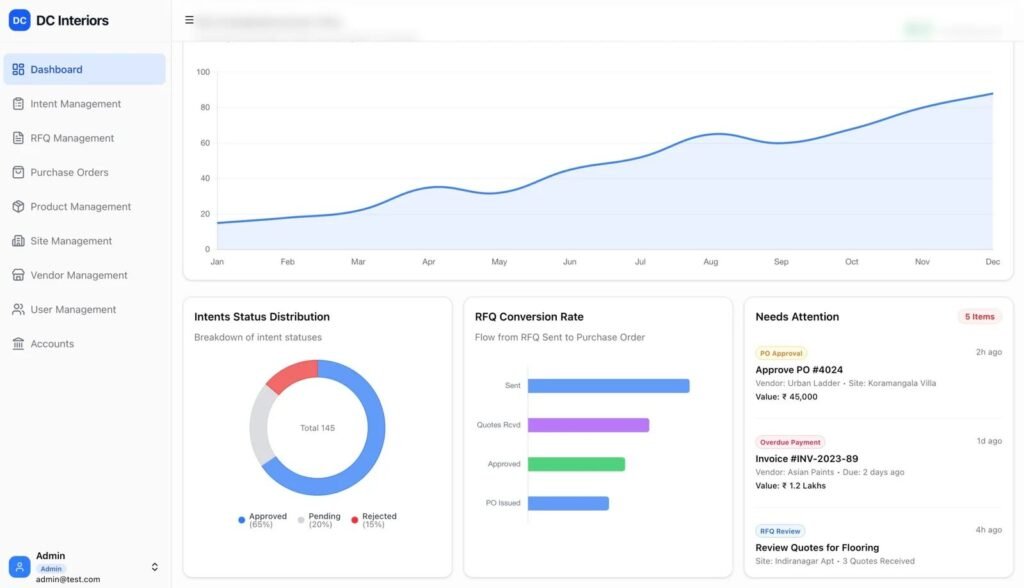
Material Intent and Procurement Workflow
Interior ERP simplifies procurement through a structured process:
- Material intent creation
- Vendor quotation request
- Quote comparison
- Purchase order approval
- Delivery tracking
This structured workflow eliminates procurement confusion and delays.
Automated Purchase Orders
The system automatically generates purchase orders from approved material intents, reducing manual errors.
Benefits include:
- Standardized PO formats
- Approval workflows
- Vendor notifications
- PO history tracking
This creates a transparent procurement pipeline.
Project Timeline Tracking
Interior projects involve multiple phases.
The ERP enables project managers to track:
- Design approvals
- Procurement timelines
- Vendor deliveries
- Installation progress
With real-time monitoring, teams can identify delays before they escalate.
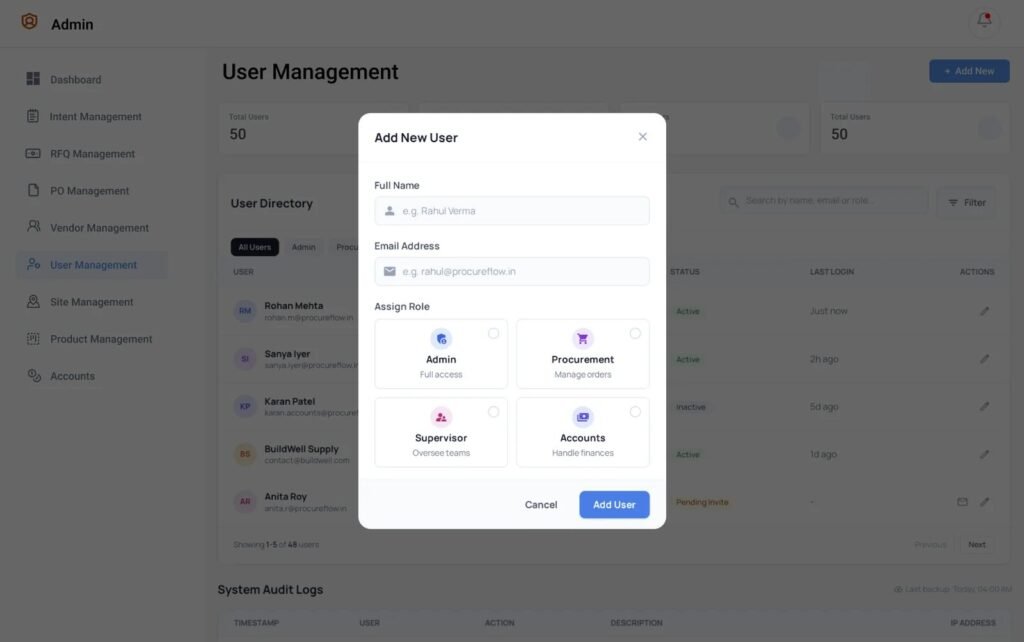
Role-Based Access Management
Different teams require different access levels.
The ERP allows role-based permissions for:
- Designers
- Procurement managers
- Project managers
- Site engineers
- Finance teams
This protects sensitive information while maintaining operational transparency.
Real-Time Project Dashboards
Project managers gain access to live dashboards showing:
- Budget utilization
- Procurement status
- Vendor deliveries
- Site progress
This gives leadership data-driven insights to make faster decisions.
Client Progress Reports
Clients can receive structured project updates including:
- Design approvals
- Procurement updates
- Installation progress
This improves client transparency and trust.
3D Design Approval Workflow
Interior design approvals often cause delays.
The ERP supports structured approval workflows for:
- 3D design renders
- Material selections
- Layout approvals
Once approved, the system automatically moves the project to procurement execution.
Site and Material Tracking
Interior ERP enables companies to track:
- Materials delivered to site
- Installation progress
- Site-level material usage
This prevents material loss and mismanagement.
Centralized Communication
Instead of scattered WhatsApp chats, the ERP stores:
- Vendor communication
- Client updates
- Internal discussions
This creates a documented communication history for every project.
Financial and Billing Management
The ERP helps track:
- Project costs
- Vendor payments
- Client billing milestones
Finance teams can monitor profitability at the project level.
Business Benefits for Interior Companies
Implementing an Interior ERP system provides significant operational advantages.
Faster Project Execution
Automation reduces delays in:
- approvals
- procurement
- vendor coordination
Projects move from planning to execution much faster.
Reduced Cost Overruns
Real-time cost tracking ensures:
- BOQ compliance
- procurement discipline
- budget monitoring
This prevents unexpected project expenses.
Better Vendor Coordination
With centralized vendor management, teams can:
- track delivery schedules
- compare vendor performance
- maintain long-term vendor relationships.
Transparent Client Communication
Clients receive structured updates, reducing:
- confusion
- miscommunication
- project disputes.
Data-Driven Decision Making
Interior companies gain valuable insights into:
- project profitability
- vendor performance
- material costs
- operational efficiency.
Scalability for Growing Firms
As interior companies grow, managing multiple projects becomes complex.
Interior ERP allows firms to scale operations without losing control.
Use Case: How an Interior Company Uses ERP
Here is a simplified project workflow using the FluteByte Interior ERP.
Step 1: Project Planning
The project manager creates a new project and prepares the BOQ and budget structure.
Step 2: Vendor Selection
Procurement teams request quotations from multiple vendors.
The system compares quotes and helps select the best option.
Step 3: Purchase Order Generation
Once approved, the ERP generates purchase orders automatically.
Step 4: Procurement and Delivery
Vendors deliver materials, which are recorded in the system.
Step 5: Site Execution
Site teams track installation progress and material consumption.
Step 6: Client Updates
Clients receive automated progress updates.
Step 7: Project Completion
Finance teams track final vendor payments and project profitability.
Why Interior Businesses Need ERP in 2026
The interior industry is rapidly evolving.
Modern clients expect:
- real-time project updates
- faster execution
- transparent budgets.
At the same time, interior companies are managing larger, more complex projects.
Key industry trends include:
- digital transformation in construction and interiors
- automation-driven project management
- centralized data systems
- scalable operations for multi-project firms.
Companies that adopt Interior ERP systems gain a competitive advantage by operating faster, smarter, and more efficiently.
Why Choose FluteByte Technologies Interior ERP
FluteByte Technologies has developed its ERP specifically for the interior design and contracting industry.
Key advantages include:
Built for Interior Workflows
Unlike generic ERPs, this system understands:
- BOQs
- vendor quotations
- material procurement
- site execution.
End-to-End Project Lifecycle Management
The ERP manages projects from:
Design → BOQ → Procurement → Execution → Billing.
Automation-Driven Processes
Workflows automate repetitive tasks like:
- purchase orders
- approvals
- project updates.
Scalable Architecture
Whether managing 5 projects or 500 projects, the ERP scales with your business.
Transform Your Interior Business with FluteByte ERP
Interior companies that rely on spreadsheets and manual coordination eventually hit a growth ceiling.
The future belongs to data-driven, system-powered interior businesses.
The FluteByte Technologies Interior ERP System empowers companies to:
- manage projects smarter
- control budgets
- improve execution speed
- deliver better client experiences.
If you are ready to bring structure, automation, and efficiency to your interior projects, it is time to adopt a powerful Interior ERP platform.
Book a demo with FluteByte Technologies today and see how your interior business can operate smarter and scale faster.
Frequently Asked Questions (SEO Optimized)
What is Interior ERP software?
Interior ERP software is a specialized management system designed for interior design companies and contractors to manage project planning, BOQs, procurement, vendors, budgets, and project execution from a centralized platform.
Why do interior design companies need ERP?
Interior companies need ERP to streamline operations, manage budgets, coordinate vendors, track project timelines, and improve client communication through a unified digital system.
How does ERP help manage BOQ and vendors?
ERP systems allow teams to create structured BOQs, request vendor quotations, compare quotes, generate purchase orders, and track procurement within one platform.
Can ERP help track interior project timelines?
Yes. Interior ERP systems provide timeline tracking, milestone monitoring, and project dashboards that allow managers to track execution progress in real time.
What makes FluteByte Technologies Interior ERP different?
FluteByte Technologies Interior ERP is specifically designed for interior design companies, offering BOQ-based budgeting, vendor management, procurement automation, and real-time project dashboards.