Interior fit-out and turnkey projects run on tight deadlines and thin margins. When your annual revenue crosses 5 crore INR, running projects through WhatsApp groups, paper challans, and fragmented Excel sheets causes operational failure. Plywood gets delivered without verification, subcontractor bills duplicate measurements, and project managers discover budget overruns only after handover.
Adopting an ERP for interior contractors stops these margin losses. It connects your estimating desk directly to job sites, factory floors, and vendor accounts.
Table of Contents
Why Spreadsheets Fail Interior Contractors Past 5 Crore INR
Spreadsheets work well when you manage two or three residential projects at a time. The founder visits the site daily, counts the material bags, and authorizes payments directly.
As soon as your company takes on four commercial fit-outs simultaneously, spreadsheets break down in three distinct areas:
[Design & BOQ] ──(Disconnected)──> [Procurement] ──(Disconnected)──> [Site GRN]
       │                                                                  │
       └── Margin leak: 4% to 8% lost in untracked site material waste ───┘
- Disconnected Data Islands: Your quantity surveyor estimates a project on an Excel template. Your purchase officer orders laminates through phone calls. Your site engineer logs receipt on paper challans. None of these three records talk to each other.
- Untracked Scope Changes: Commercial clients frequently change wall partitions, electrical layouts, and ceiling finishes. When site engineers execute variations without instant budget logging, your company pays for the extra labor and material while failing to bill the client.
- Ghost Deliveries and Theft: Without immediate three-way matching between the Purchase Order, physical Goods Receipt Note (GRN), and vendor bill, material leaves job sites unrecorded.
According to procurement benchmarking studies by the Project Management Institute, unmonitored scope creep and procurement discrepancies reduce planned contractor profits by an average of 11% per project.
Five Core Functions of an ERP for Interior Contractors
A functional software platform must handle the daily realities of the construction site and the joinery workshop.
1. Automated Bill of Quantities (BOQ) and Rate Analysis
Manual entry of estimation data causes calculation errors that destroy project profitability before work starts. A dedicated system allows you to import client tender estimates directly.
The platform breaks every line item into four cost components:
- Core materials (plywood, gypsum boards, framing metal, veneer, hardware)
- Direct labor costs (carpentry, POP, electrical, painting)
- Subcontracted turnkey packages (HVAC, fire suppression, glass facades)
- Target gross profit margins
Once the client signs the contract, the software freezes the baseline numbers. A site supervisor cannot request 250 sheets of moisture-resistant plywood if the BOQ only allocates 200 sheets, unless the project director registers a formal client change order.
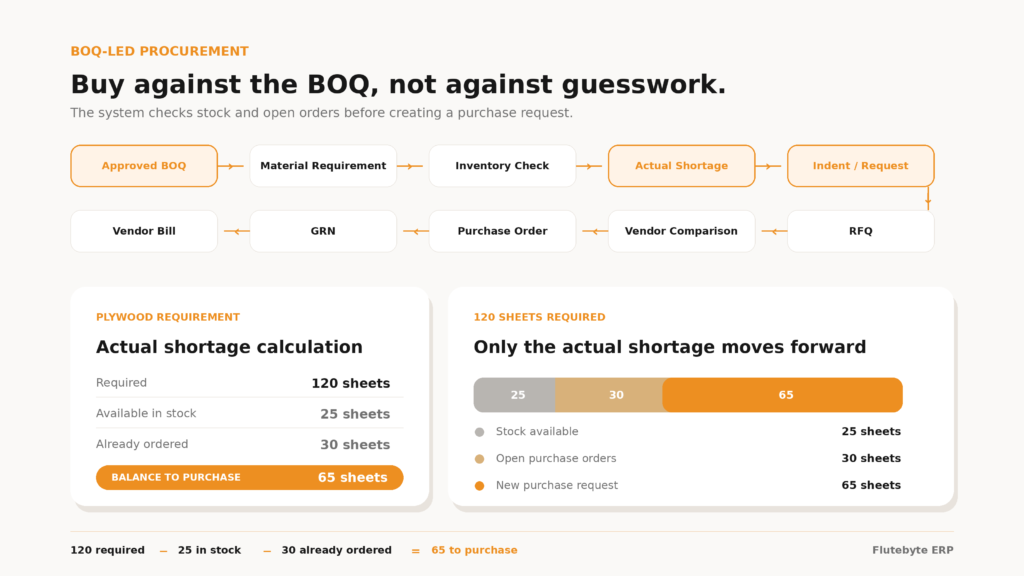
2. Purchase Indents, Comparative Statements, and Digital POs
Procurement desks frequently buy from familiar vendors instead of securing the best market price.
An interior ERP automates this process:
- Site supervisors raise material indents directly on their phones.
- The procurement team sends digital Requests for Quotation (RFQs) to three registered vendors simultaneously.
- The system generates an automated comparative statement ranking vendors by unit rate, delivery timeframe, credit terms, and GST compliance.
- One click converts the selected quotation into a legally binding Purchase Order (PO).
3. Mobile Goods Receipt Notes (GRN) on the Job Site
Most material loss occurs during delivery. Delivery drivers drop off incomplete orders, site supervisors sign delivery slips without counting boxes, and suppliers send bills for full quantities.
With mobile site execution software, the site storekeeper must:
- Select the specific PO on a mobile phone.
- Enter the exact count of items unloaded.
- Upload photos of the physical delivery challan and the material stack.
If the purchase order specifies 100 boxes of acoustic ceiling tiles and the supplier delivers 80, the system marks the PO as partially fulfilled. Accounts teams cannot release payment for the missing 20 boxes.
4. Subcontractor Measurement Sheets and Running Account (RA) Billing
Subcontractors such as false ceiling teams, painters, and electrical gangs frequently submit inflated running bills. Checking these claims manually across multiple sites consumes days of engineering time.
The software replaces paper measurement sheets. Your site engineer records actual physical dimensions directly into the mobile module. The software applies the agreed contractual unit rate, deducts statutory retention money (typically 5%), recovers material debits issued from your inventory, and prepares the net payment voucher automatically.
5. Dual-Track Payroll for Corporate Staff and Daily Labor
Interior contracting relies on a split workforce. Your corporate office employs salaried estimators, designers, and accountants. Your job sites employ daily wage carpenters, masons, and contract gangs.
The ERP handles both payroll structures:
- Office staff receive standard monthly salary slips with automated PF, ESIC, and professional tax calculations.
- Site laborers are tracked through daily foreman headcounts, supervisor photo attendance, or piece-rate measurement outputs. The software books these wage expenses directly to the specific project ledger, giving you an accurate picture of actual site costs.
Software Comparison: Generic Tools vs Specialized Platforms
Contractors evaluating software face three main options.
| Software Category | Core Strengths | Operational Drawbacks | Best Suited For |
| Generic Off-The-Shelf SaaS (Zoho Projects, Monday.com) | Low upfront cost, fast setup, clean visual boards | No native BOQ parsing, no subcontractor measurement sheets, weak field inventory control | Design studios managing 1 to 3 residential projects without site execution |
| Enterprise Construction ERP (StrategicERP, eresource Nfra) | Robust accounting compliance, handles heavy civil machinery | Complex desktop interfaces, high consultant implementation costs, slow mobile adoption | Large EPC infrastructure and road contractors |
| Custom Fit-Out ERP (FluteByte Custom Software) | Engineered around your exact company approval gates, mobile-first site entry, zero per-seat fees | Requires upfront development investment | Turnkey fit-out firms and interior contractors scaling beyond 5 crore INR |
Why Fit-Out Firms Choose FluteByte
Generic tools charge monthly fees for every user. If you employ 30 site supervisors, your monthly software subscription increases rapidly. Furthermore, generic platforms force your supervisors to navigate desktop interfaces built for corporate accountants.
FluteByte designs custom platforms engineered around your company’s operational hierarchy. You own the software, control your database, and run your daily operations without paying per-user monthly penalties.
Step-by-Step Implementation Strategy for Job Sites
Most software implementations fail because site staff refuse to use complex tools. Follow this four-stage plan to ensure full field adoption:
Month 1: Procurement & PO ──> Month 2: Mobile GRN ──> Month 3: BOQ & Billing ──> Month 4: Payroll
- Start with Material Indents and POs (Weeks 1 to 4): Restrict initial software use to the head office purchase desk. Require all vendor orders to generate through the system. This step requires no field training and brings immediate visibility to monthly company expenditure.
- Roll Out Mobile GRN to Site Supervisors (Weeks 5 to 8): Train site storekeepers to log deliveries on their mobile phones. Use photo capture requirements instead of lengthy text forms. Make it clear to vendors that invoices will not clear without a digital GRN match.
- Integrate BOQ Tracking and RA Billing (Weeks 9 to 12): Move estimation files into the software. Require quantity surveyors to log work completion measurements digitally before releasing subcontractor payments.
- Deploy Labor Attendance and P&L Dashboards (Weeks 13 to 16): Connect daily labor headcounts to project cost codes. Management now reviews daily cost-versus-budget reports for every active project.
For an analysis of field rollout procedures, explore our guide on turnkey project management systems.
Calculating Return on Investment for Fit-Out ERP
Investing in specialized software is a financial decision designed to recover leaked capital.
Consider an interior turnkey firm executing 12 crore INR in commercial contracts annually:
- Material Leakage Reduction: Unmonitored site delivery discrepancies, over-ordering, and unrecorded damage account for roughly 3% of total project costs (36 lakh INR). Enforcing three-way PO-GRN matching reduces this loss by at least half, saving 18 lakh INR annually.
- Preventing Unbilled Client Variations: Projects routinely carry 2% to 4% in unbilled extra scope because site changes go unrecorded. Capturing these variations adds 24 lakh INR in billable work to your top line.
- Subcontractor Overbilling: Accurate digital measurement sheets eliminate duplicate measurement claims, protecting another 6 lakh INR per year.
Total Annual Margin Recovery: 18 Lakhs + 24 Lakhs + 6 Lakhs = 48 Lakh INR
The recovered capital far exceeds the cost of building or implementing a custom management system, with the software paying for itself within the first two quarters of deployment.
Frequently Asked Questions
1. What does an ERP for interior contractors actually do?
An ERP for interior contractors is a unified management system that automates project estimation (BOQ), material purchasing, job-site delivery tracking (GRN), subcontractor measurement verification, client billing, and daily site labor attendance.
2. How does the software handle material wastage on site?
The system compares original BOQ material estimates against actual site indents. If a project manager requests materials beyond the approved budget tolerance (such as 5% for tile cutting), the software flags the excess indent and requires management authorization before creating a purchase order.
3. Can our site engineers use the system without reliable internet?
Yes. Modern platforms built by FluteByte incorporate offline data storage. Supervisors record material arrivals, take challan photos, and log worker attendance without an active mobile connection. The app stores entries locally and uploads them once the device reconnects to mobile data.
4. Why is generic ERP software unsuitable for interior businesses?
Generic ERP systems serve standard retail, trading, and manufacturing operations. They lack tools for progressive running account (RA) billing, architectural BOQ rate breakdown, and subcontractor measurement entries, forcing contractors to maintain auxiliary spreadsheets.
5. How long does it take to implement an interior ERP?
A focused deployment takes between 8 and 12 weeks. Companies achieve the highest success rate by deploying modules in phases, beginning with procurement and inventory before expanding to subcontractor billing and payroll.
6. Can the ERP integrate with accounting software like Tally Prime?
Yes. Professional systems use API connectors to sync approved vendor invoices, client bills, and payment vouchers directly with accounting software like Tally Prime or Zoho Books, eliminating repetitive data entry.
7. What is the difference between commercial SaaS and a FluteByte custom build?
Commercial SaaS products charge recurring monthly fees for every active user and restrict custom modifications. FluteByte builds a tailored software asset that your company owns outright, allowing unlimited user access without recurring seat licenses.
8. How does the software manage client variation orders?
When a client requests design changes on site, the project manager logs a variation entry in the mobile application. The software estimates the additional material and labor costs, creates a formal change order document for client approval, and updates the project budget once signed.
Take Control of Your Project Margins
Running complex commercial fit-outs and turnkey projects on spreadsheets guarantees margin leakage, communication breakdowns, and delayed deliveries.
Moving your operations to a specialized ERP for interior contractors gives your management team complete visibility over material purchases, site progress, and subcontractor billing.
- To audit your current workflows and review software options, speak with our engineering team at FluteByte Contact.
- Review our technical architecture and operational modules at FluteByte Custom ERP.