Welcome to Flutebyte Technologies
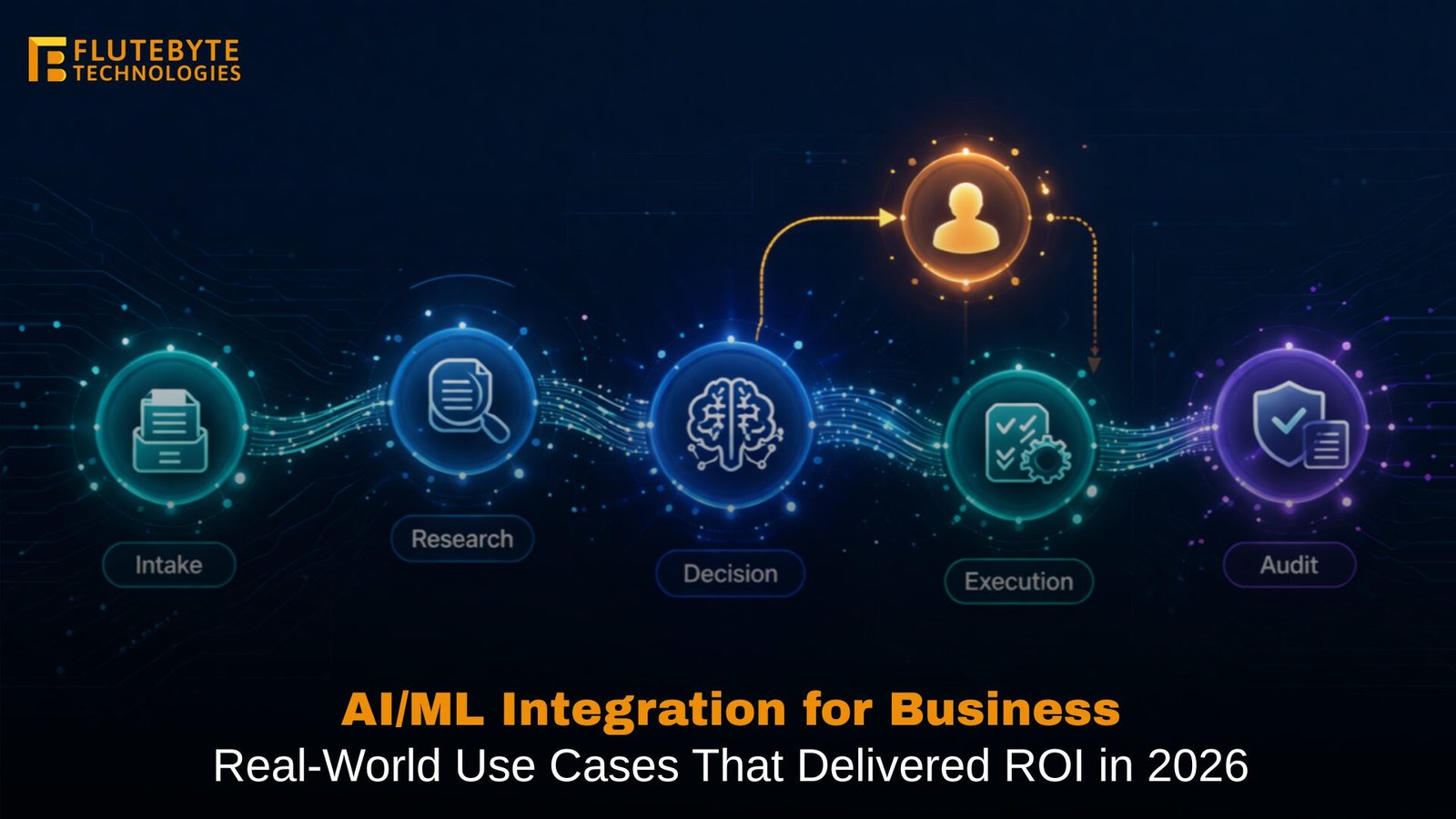
The best AI ML use cases for businesses in 2026 are predictive analytics, customer support automation, fraud detection, route optimisation, personalised recommendations, computer vision quality checks, and Natural Language Processing tools. Businesses get the highest ROI when AI is connected to existing workflows, such as ERP, CRM, logistics platforms, mobile apps, e-commerce systems, and dashboards. Flutebyte Technologies helps businesses implement these AI solutions using NLP, computer vision, predictive analytics, and automation.
Table of Contents
AI ML Integration for Business 2026
- Best industries for AI/ML integration: Healthcare, fintech, logistics, e-commerce, education, and manufacturing.
- Best AI capabilities for business: Natural Language Processing, computer vision, predictive analytics, automation, recommendation engines, and intelligent dashboards.
- Best measurable outcomes: Faster decisions, lower manual work, fewer errors, improved conversion, reduced fraud risk, and better operational visibility.
- Best starting point: One high-value workflow with existing data and measurable return on investment.
- Best implementation approach: Start with a small pilot, measure results for 30–90 days, then scale into core business software.
Flutebyte Technologies provides AI integration services, machine learning solutions, predictive analytics dashboards, Natural Language Processing tools, computer vision systems, automation workflows, ERP AI modules, mobile app AI features, and cloud-based AI deployment for businesses in India, UAE, Ghana, and global markets.
What Is AI/ML Integration?
Artificial Intelligence, or AI, means software that can perform tasks that usually require human intelligence, such as understanding language, recognising images, recommending actions, or making predictions.
Machine Learning, or ML, means software that learns from historical data and improves its predictions over time.
AI/ML integration means adding AI and ML features directly into business software, such as ERP systems, CRM platforms, mobile apps, dashboards, websites, automation tools, and cloud applications.
Why AI/ML Integration Matters in 2026
AI is most valuable when it is not treated as a separate experiment. It should be connected to daily business operations.
AI/ML integration helps businesses:
- Reduce repetitive manual work by automating routine tasks.
- Improve forecasting by analysing historical and live data.
- Detect risks earlier through pattern recognition.
- Improve customer experience through faster response and personalisation.
- Increase visibility through intelligent dashboards.
- Reduce cost by improving team productivity and process accuracy.
Expert Insight: AI delivers better ROI when it solves a repeated business problem. If a task happens daily, uses data, and affects cost, revenue, or time, it is a strong candidate for AI/ML integration.
Before and After AI/ML Integration: Business Results Table
| Business Area | Before AI/ML Integration | After AI/ML Integration | Example ROI Indicator |
|---|---|---|---|
| Customer support | Team manually answered repeated questions | NLP chatbot handled common questions and escalated complex cases | 30%–50% fewer repetitive tickets |
| Inventory planning | Stock ordered using spreadsheets or guesswork | Predictive analytics forecasted demand | 15%–35% better demand accuracy |
| Finance risk | Fraud checks were manual and delayed | ML model scored transactions in real time | 10%–25% reduction in fraud-related losses |
| Logistics | Routes planned manually | AI suggested efficient routes and delivery time predictions | 10%–20% fuel or time saving |
| E-commerce | Same product suggestions shown to all users | Recommendation engine personalised products | 5%–20% higher conversion rate |
| Manufacturing | Repairs happened after breakdown | Predictive maintenance alerted teams earlier | 20%–40% lower downtime risk |
These figures are practical planning ranges. Actual results depend on data quality, workflow complexity, user adoption, and how deeply AI is integrated into the company’s software.
6 Real-World AI/ML Use Cases by Industry
1. Healthcare AI Use Case
Industry → Healthcare
Healthcare businesses include clinics, diagnostic centres, hospitals, wellness platforms, health technology companies, and patient service providers.
Problem → High manual workload and delayed patient response
Healthcare teams often manage large volumes of patient calls, WhatsApp messages, website forms, reports, insurance documents, and appointment requests.
Common problems include:
- Repeated patient questions.
- Manual appointment prioritisation.
- Slow medical report sorting.
- Missed follow-up reminders.
- Difficulty routing patient queries.
- High pressure on front-desk and support teams.
For example, a clinic receiving 1,000 patient queries per month may spend 100+ staff hours only on basic query handling, appointment updates, and follow-up reminders.
Solution → NLP-based triage, document automation, and predictive patient support
Flutebyte Technologies can integrate healthcare AI using:
- Natural Language Processing: To understand patient messages and classify queries.
- Automation: To send appointment reminders, follow-up alerts, and report notifications.
- Predictive analytics: To identify high-risk follow-up cases or missed appointment patterns.
- Document intelligence: To classify reports, prescriptions, and insurance files.
Outcome → Faster response and better patient coordination
Expected outcomes may include:
- 25%–40% reduction in front-desk query load.
- 15%–30% faster report sorting.
- 20%–35% improvement in follow-up reminders.
- 10%–20% fewer missed appointments.
Why this works
Healthcare AI works because many patient support tasks are repeated, text-heavy, and time-sensitive. Natural Language Processing can classify patient messages faster than manual sorting, while automation ensures reminders are sent on time. Predictive analytics helps healthcare teams identify which patients may need follow-up earlier, improving service quality without increasing staff workload.
Expert Insight: Healthcare AI should assist human teams, not replace medical judgement. For patient-facing systems, Flutebyte Technologies recommends human review for sensitive cases, access control for patient data, and clear escalation rules.
2. Fintech AI Use Case
Industry → Fintech
Fintech means financial technology. It includes lending apps, payment platforms, insurance technology companies, digital wallets, investment tools, and financial service portals.
Problem → Fraud risk, slow review, and high compliance workload
Fintech companies handle large volumes of transactions, documents, customer profiles, and risk checks.
Common problems include:
- Manual fraud review.
- Slow loan application screening.
- Delayed Know Your Customer verification.
- Suspicious transaction monitoring.
- High compliance workload.
- Poor real-time risk visibility.
For example, if a lending platform receives 1,000 applications per day and each application needs 5 minutes of manual screening, the team spends more than 80 hours per day on first-level review.
Solution → Fraud detection, risk scoring, and document intelligence
Flutebyte Technologies can build fintech AI solutions using:
- Predictive analytics: To score loan risk and repayment probability.
- Machine learning models: To detect transaction anomalies.
- Natural Language Processing: To read and classify customer documents.
- Automation: To trigger alerts, approval workflows, and risk flags.
- Dashboards: To show risk scores, approval status, and suspicious activity.
Outcome → Faster approvals and lower financial risk
Expected outcomes may include:
- 10%–25% reduction in fraud-related losses.
- 20%–40% faster loan screening.
- 30%–60% faster document verification.
- 15%–30% reduction in manual risk review workload.
Why this works
Fintech AI works because financial risk patterns can often be detected from historical transaction data, location data, device behaviour, payment frequency, and document patterns. Machine learning models can flag unusual activity faster than manual review. When AI risk scoring is combined with human approval, fintech companies can improve speed without removing control.
Expert Insight: In fintech, AI should not be a black box. A good system should explain why a transaction, loan, or user profile was flagged, so business teams can review risk confidently.
3. Logistics AI Use Case
Industry → Logistics
Logistics includes transport companies, delivery services, courier networks, supply chain operators, warehouse teams, and route-based field operations.
Problem → Manual route planning and poor delivery visibility
Logistics companies depend on time, route efficiency, fuel usage, driver allocation, and customer updates.
Common problems include:
- Manual route planning.
- High fuel cost.
- Poor driver allocation.
- Delivery delay uncertainty.
- Repeated customer status queries.
- Limited visibility across vehicles and warehouses.
For example, if a dispatch team spends 3 hours per day planning routes manually, that becomes around 90 hours per month on one recurring operational task.
Solution → Route optimisation, delivery prediction, and automated alerts
Flutebyte Technologies can build logistics AI solutions using:
- Predictive analytics: To estimate delivery delays.
- Automation: To send customer delivery updates.
- Machine learning: To improve driver allocation based on past performance.
- Optimisation models: To suggest efficient routes.
- Dashboards: To track vehicles, delays, trips, and delivery performance.
Outcome → Faster dispatch and reduced coordination work
Expected outcomes may include:
- 10%–20% reduction in fuel or travel time.
- 15%–30% faster route planning.
- 10%–25% better vehicle utilisation.
- 20%–40% fewer customer delivery status queries.
Why this works
Logistics AI works because route planning and delivery prediction are data-rich problems. Distance, traffic, driver availability, vehicle capacity, previous delivery time, warehouse location, and customer location can all be used to improve planning. When AI is connected to maps, driver apps, customer notifications, and dispatch dashboards, it reduces manual coordination and improves delivery reliability.
Expert Insight: Logistics AI should be integrated into the actual dispatch workflow. A prediction shown on a separate dashboard is less useful than a prediction that automatically triggers driver allocation, customer notification, or route adjustment.
4. E-Commerce AI Use Case
Industry → E-commerce
E-commerce includes online stores, marketplaces, grocery platforms, fashion websites, retail apps, and business-to-business commerce platforms.
Problem → Low conversion and generic customer experience
Many e-commerce brands get traffic but fail to convert enough visitors into buyers.
Common problems include:
- Same product suggestions for every user.
- High cart abandonment.
- Low repeat purchase rate.
- Manual customer segmentation.
- Weak search results.
- Repetitive product support questions.
For example, if an online store has 10,000 monthly visitors and a 1.5% conversion rate, increasing conversion to 2% can create 50 additional orders per month.
Solution → Recommendations, customer segmentation, and NLP support
Flutebyte Technologies can build e-commerce AI solutions using:
- Recommendation engines: To suggest products based on browsing and purchase behaviour.
- Predictive analytics: To predict cart abandonment and repeat purchase probability.
- Natural Language Processing: To answer product questions and classify customer messages.
- Automation: To trigger abandoned cart reminders and personalised campaigns.
- Dashboards: To track conversion, order value, retention, and customer segments.
Outcome → Higher conversion and better retention
Expected outcomes may include:
- 5%–20% higher conversion rate.
- 10%–30% higher average order value.
- 15%–35% better repeat purchase targeting.
- 20%–50% fewer repetitive support queries.
Why this works
E-commerce AI works because every customer leaves behavioural signals through searches, clicks, product views, carts, purchases, and reviews. AI can use these signals to personalise product recommendations, predict buying intent, and trigger timely follow-ups. This improves the shopping experience while helping the business increase revenue from existing traffic.
Expert Insight: For e-commerce companies, the fastest AI ROI often comes from product recommendations, abandoned cart recovery, and customer support automation because these workflows directly affect sales and service cost.
5. Education AI Use Case
Industry → Education
Education businesses include schools, coaching institutes, universities, learning apps, online course platforms, training academies, and corporate learning systems.
Problem → Same learning path for every student
Education platforms often give the same lessons, quizzes, and support to every learner, even when students have different strengths and weak areas.
Common problems include:
- Low course completion rate.
- Slow student support.
- Difficulty identifying weak learners.
- Manual quiz creation.
- Generic learning paths.
- Limited engagement tracking.
For example, if 1,000 students join a course and only 400 complete it, the platform has a 40% completion rate. AI can help identify where learners drop off and what type of support they need.
Solution → Personalised learning, AI tutor, and learner analytics
Flutebyte Technologies can build education AI solutions using:
- Predictive analytics: To detect dropout risk and weak performance areas.
- Natural Language Processing: To power AI tutors and student support chatbots.
- Automation: To send learning reminders and progress alerts.
- Recommendation systems: To suggest lessons, quizzes, and revision content.
- Dashboards: To show learner progress, completion rate, and engagement.
Outcome → Better completion and faster learner support
Expected outcomes may include:
- 10%–30% improvement in course completion.
- 15%–35% faster student query resolution.
- 20%–40% reduction in manual academic support work.
- 10%–25% better learner engagement tracking.
Why this works
Education AI works because learning behaviour creates useful signals, such as quiz scores, time spent, lesson completion, wrong answers, attendance, and engagement. AI can identify patterns that teachers may not notice early enough. When personalised recommendations and support automation are added, learners receive help at the right time instead of waiting until they fall behind.
Expert Insight: Education AI should support teachers and trainers. It should make learning gaps visible earlier, not remove human guidance from the learning process.
6. Manufacturing AI Use Case
Industry → Manufacturing
Manufacturing includes factories, production units, furniture manufacturing, food processing, textile units, engineering companies, packaging units, and industrial suppliers.
Problem → Downtime, quality issues, and weak production visibility
Manufacturing companies lose money when machines stop, materials run short, production is delayed, or quality problems are discovered late.
Common problems include:
- Unplanned machine breakdown.
- Manual quality inspection.
- Production delays.
- Raw material wastage.
- Spreadsheet-based planning.
- Poor visibility across purchase, inventory, production, and dispatch.
For example, if one machine breakdown causes 8 hours of production loss, the impact includes idle labour, delayed dispatch, repair cost, and customer delivery risk.
Solution → Predictive maintenance, computer vision, and ERP-connected analytics
Flutebyte Technologies can build manufacturing AI solutions using:
- Predictive analytics: To forecast machine failure, material shortage, or production delay.
- Computer vision: To detect defects from images or camera feeds.
- Automation: To trigger maintenance alerts, stock alerts, and quality escalations.
- Machine learning: To improve production planning using historical output data.
- ERP integration: To connect AI with purchase, inventory, production, quality, and dispatch modules.
Outcome → Lower downtime and better production control
Expected outcomes may include:
- 20%–40% reduction in downtime risk.
- 10%–25% better production planning accuracy.
- 15%–35% faster quality inspection.
- 10%–20% lower raw material wastage.
Why this works
Manufacturing AI works because machines, production lines, inventory systems, and quality checks generate repeated operational data. Predictive analytics can identify early warning signs before breakdowns happen. Computer vision can detect visual defects faster than manual inspection in selected workflows. When AI is connected to ERP, managers get earlier alerts and better control over production decisions.
Expert Insight: Manufacturing AI should not stay limited to the factory floor. The strongest ROI comes when AI alerts are connected to ERP actions, such as purchase planning, maintenance scheduling, production status, and quality approval.
Definition Box: Core AI Capabilities Used in Business
- Natural Language Processing: AI that understands text, chat, email, documents, and voice transcripts.
- Computer Vision: AI that analyses images or video to detect objects, defects, patterns, or visual changes.
- Predictive Analytics: AI that uses historical and live data to forecast future outcomes.
- Automation: Software workflows that complete repetitive tasks without manual effort.
- Recommendation Engine: AI that suggests products, content, actions, or next steps based on user behaviour.
- Anomaly Detection: AI that identifies unusual activity, such as fraud, machine failure, or abnormal transactions.
Machine Learning Use Cases Enterprise Teams Should Prioritise
Enterprise teams should prioritise AI/ML projects where the business already has usable data and repeated decisions.
High-value machine learning use cases include:
- Demand forecasting using sales history.
- Customer churn prediction using user behaviour.
- Fraud detection using transaction data.
- Predictive maintenance using machine logs.
- Lead scoring using sales activity.
- Invoice matching using finance data.
- Sentiment analysis using customer messages.
- Price optimisation using order history.
- Workforce planning using attendance data.
- Inventory replenishment using stock movement.
Expert Insight: A strong AI use case has three qualities: existing data, repeated decision-making, and a measurable outcome. If a business cannot measure the outcome, it should refine the use case before development begins.
3 Anonymised Client Scenario Examples
Scenario 1: Manufacturing Company Reduced Maintenance Pressure
A mid-size manufacturing company was using manual machine logs and spreadsheet-based maintenance planning.
- Problem: Machine issues were discovered late, and maintenance was reactive.
- Solution: AI-powered predictive maintenance dashboard connected with production data.
- Outcome: Downtime risk reduced by an estimated 25%, and maintenance planning became 30% faster.
Standalone insight: Predictive maintenance creates ROI because it shifts teams from emergency repair to planned maintenance. This reduces disruption, improves spare part planning, and gives production managers earlier warning before output is affected.
Scenario 2: E-Commerce Brand Improved Conversion
An online retail business had traffic but low repeat purchase activity.
- Problem: Product suggestions were generic, and customer segmentation was manual.
- Solution: AI recommendation engine and customer behaviour prediction model.
- Outcome: Conversion improved by an estimated 12%, and repeat purchase targeting improved by 22%.
Standalone insight: AI recommendations improve e-commerce ROI because they use customer behaviour to show more relevant products. This increases the value of existing website traffic without depending only on higher advertising spend.
Scenario 3: Logistics Company Improved Dispatch Planning
A logistics company was planning routes and delivery updates manually.
- Problem: Dispatch planning took several hours daily, and customers frequently asked for delivery status.
- Solution: AI route optimisation, delivery delay prediction, and automated customer notifications.
- Outcome: Route planning became 25% faster, and delivery-related customer queries reduced by 35%.
Standalone insight: Logistics AI creates ROI by reducing manual coordination. When route planning, delay prediction, and customer notifications are connected, operations teams save time and customers receive better visibility.
How to Choose an AI Integration Partner: 5 Criteria
Choosing the right AI integration partner is important because AI projects need more than model development. They need business understanding, clean data, software integration, testing, user adoption, and long-term support.
1. Business-first AI consulting
A good AI partner should start with the business problem, not the technology.
Look for a team that can define:
- The workflow AI will improve.
- The data needed.
- The expected return on investment.
- The users involved.
- The success metric.
Why this matters: AI without a business goal becomes an experiment. AI with a measurable target becomes an investment.
2. Strong software engineering capability
AI must work inside real software systems.
A strong AI partner should understand:
- ERP systems.
- CRM systems.
- Mobile apps.
- Web applications.
- Cloud infrastructure.
- Application Programming Interface integrations.
- Databases.
- Dashboards.
Why this matters: A model alone does not create ROI. ROI comes when the model is integrated into the software your team uses every day.
3. Multiple AI capabilities under one team
A practical AI partner should support more than one AI capability.
Important capabilities include:
- Natural Language Processing.
- Computer vision.
- Predictive analytics.
- Automation.
- Recommendation engines.
- Intelligent dashboards.
- Data engineering.
- Cloud deployment.
Why this matters: Different business problems need different AI methods. A chatbot needs NLP, a quality inspection tool may need computer vision, and a stock planning system may need predictive analytics.
4. Clear pilot-to-scale approach
A reliable AI partner should not push a large project before proving value.
A good pilot should include:
- One use case.
- One department or workflow.
- One measurable target.
- One clear timeline.
- One feedback loop.
- One scale-up plan.
Why this matters: AI success improves when businesses test small, measure results, and scale only what works.
5. Long-term maintenance and improvement
AI systems need monitoring and improvement after launch.
A good AI partner should provide:
- Model monitoring.
- Performance review.
- Data updates.
- Bug fixes.
- Security updates.
- User feedback improvements.
- Feature enhancements.
- Cloud support.
Why this matters: Business data changes over time. AI models must be reviewed and improved so they remain accurate, useful, and reliable.
Expert Insight: Flutebyte Technologies is positioned as an AI integration partner because it combines AI capabilities with custom software development, ERP development, mobile app development, web application development, automation, cloud deployment, UI/UX design, and long-term support.
How to Start AI/ML Integration in 2026
Businesses should start AI implementation with a clear and measurable use case.
Recommended steps:
- Identify one measurable problem.
Example: Reduce customer support tickets by 30%. - Check available data.
Example: Support tickets, sales history, machine logs, delivery data, or customer behaviour. - Select one AI method.
Example: NLP for customer support, computer vision for quality inspection, or predictive analytics for forecasting. - Build a pilot.
Example: Test one workflow for 30–90 days. - Measure results.
Example: Time saved, cost reduced, accuracy improved, or revenue increased. - Integrate into core software.
Example: Add successful AI features into ERP, CRM, dashboards, mobile apps, or web platforms. - Improve continuously.
Example: Update the model with new data and user feedback.
Common Mistakes That Reduce AI ROI
AI projects often fail when businesses focus on technology before business value.
Common mistakes include:
- Starting without a measurable use case.
- Using poor-quality data.
- Expecting 100% accuracy.
- Not integrating AI with daily workflows.
- Ignoring user training.
- Skipping human review for important decisions.
- Building too many AI features in version one.
- Not measuring return on investment.
- Using AI where simple automation would be enough.
- Not maintaining the AI model after launch.
Expert Insight: Not every business problem needs AI. Sometimes a dashboard, rule-based automation, or better ERP workflow can deliver faster ROI than a machine learning model.
FAQ: AI ML Integration for Business 2026
Q1. What are the best AI ML use cases for businesses in 2026?
The best AI ML use cases for businesses in 2026 include predictive analytics, fraud detection, customer support automation, route optimisation, product recommendations, personalised learning, computer vision quality checks, and predictive maintenance. These use cases work well because they improve measurable business outcomes such as cost, time, risk, accuracy, and revenue.
Q2. What is predictive analytics ROI?
Predictive analytics ROI means the measurable value a business gets from using data to predict future outcomes. For example, a manufacturer may reduce downtime risk by 20%–40%, or an e-commerce company may improve demand forecasting by 15%–35%.
Q3. How can NLP tools help businesses?
NLP tools help businesses understand and process human language from chats, emails, documents, support tickets, and voice transcripts. They are useful for chatbots, ticket routing, sentiment analysis, document summaries, invoice extraction, and automated customer support.
Q4. How does computer vision help businesses?
Computer vision helps businesses analyse images or video to detect defects, objects, patterns, or visual changes. In manufacturing, it can support quality inspection; in logistics, it can support package verification; and in retail, it can support shelf or product monitoring.
Q5. Why should businesses choose AI integration services India?
AI integration services India are useful for businesses that want skilled development, cost-effective delivery, and long-term technical support. Indian AI teams can build NLP tools, predictive analytics dashboards, computer vision systems, automation workflows, and AI-enabled ERP or mobile app features.
Q6. How should a company start its first AI project?
A company should start with one measurable business problem, one available dataset, and one workflow where AI can create visible improvement. The safest approach is to build a pilot, measure results for 30–90 days, and then scale the solution into existing software.
Get a Free AI Readiness Consultation
Want to know where AI can create measurable ROI in your business?
Flutebyte Technologies provides AI/ML integration, AI integration services India, predictive analytics dashboards, NLP tools for business, computer vision solutions, machine learning systems, ERP AI modules, mobile app AI features, business automation, and cloud-based AI deployment.
Contact Flutebyte Technologies for a free AI readiness consultation. Our team will help you identify practical AI use cases, review your current data, and prepare a clear roadmap for AI-powered business growth.